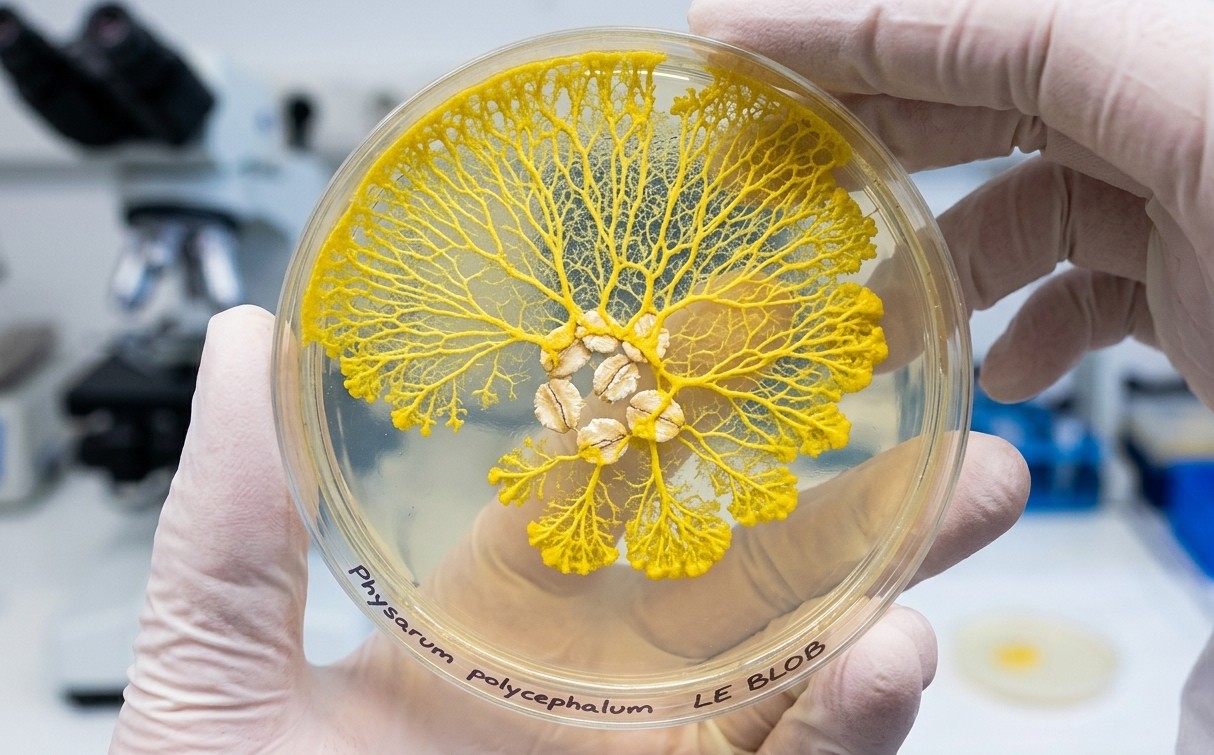
Physarum polycephalum
In 2000, a brainless single-celled organism redesigned the Tokyo subway network more efficiently than human engineers. No neurons, no eyes, no nervous system. Welcome to the world of slime mold.
From the fundamentals to advanced biology, everything science knows about this extraordinary organism.
From optimization algorithms to neuromorphic chips, slime mold inspires a new generation of technologies.
Slime mold is one of the easiest and most fascinating organisms to observe at home. Here's everything you need to know.
Quizzes, simulator, true or false: test your knowledge and visualize slime mold behavior.
Plasmodium, myxomycete, coenocyte... All the scientific terms explained in plain English.
10 questions to test your knowledge, from casual curiosity to expert-level science.
In 2000, Japanese scientists placed slime mold on a map of the Tokyo area, with oat flakes at the locations of major train stations. Within hours, the organism had built a network nearly identical to the actual rail system, considered one of the most efficient in the world.
Unlike animals that have only two sexes, slime mold has more than 720. This means it can reproduce with the vast majority of individuals of its species that it encounters in the wild.