The famous maze experiment
In 2000, Japanese researcher Toshiyuki Nakagaki published a groundbreaking paper in Nature demonstrating that Physarum polycephalum could solve a maze. He placed slime mold throughout a small plastic maze, put food at two separate points (the "entrance" and "exit"), and watched. Within hours, the slime mold had retracted from all dead ends and formed a single thick tube connecting the two food sources along the shortest possible path.
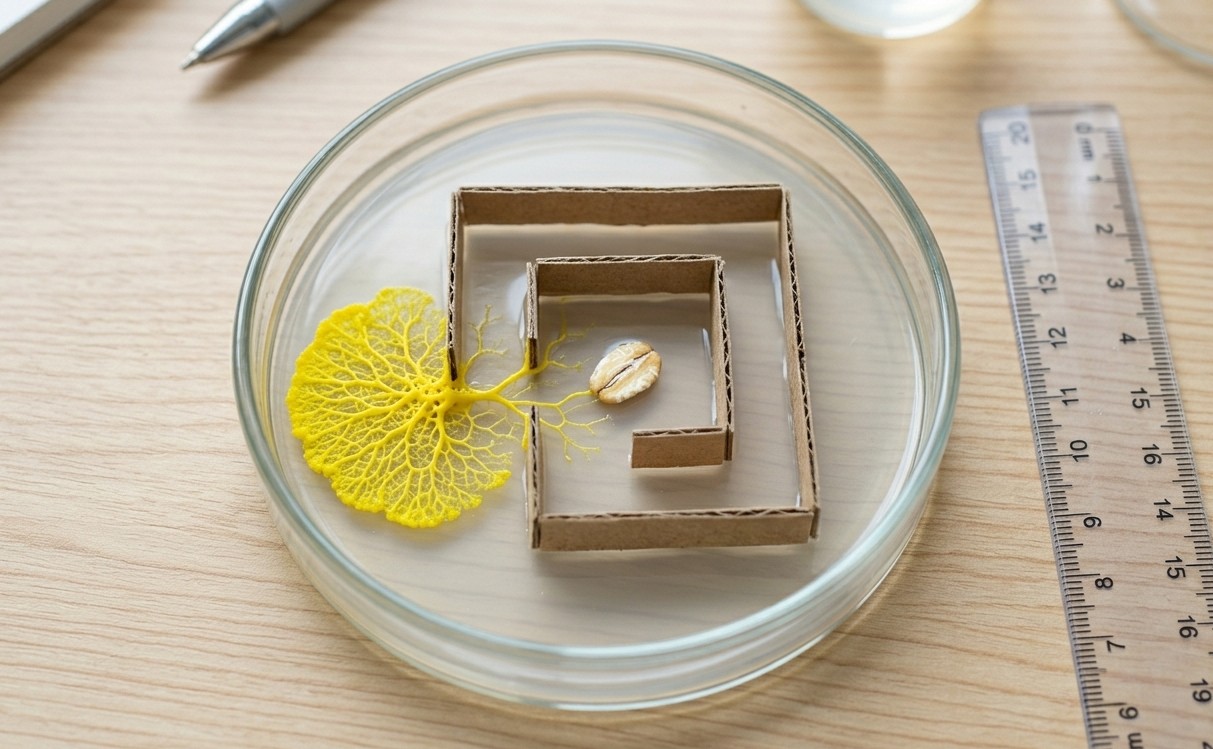
This experiment can be recreated at home with simple materials. It works reliably and never gets old, because the organism genuinely solves the puzzle each time through a decentralized biological algorithm.
Materials needed
- A healthy, active Physarum polycephalum culture (see growing guide)
- A clean, flat container: Petri dish (9-15 cm), shallow food container, or acrylic sheet
- Maze-building material: plastic strips, cardboard, modeling clay, or 3D-printed walls
- Plain 2% agar (or damp paper towel as substrate)
- Rolled oats for food sources
- Non-chlorinated water
- Aluminum foil or dark cloth for covering
- Camera or phone for documentation (optional but recommended)
Five maze designs
Design 1: The simple T-maze
Difficulty: Beginner
Best for: First-time experiments, young students
A T-shaped junction with one path leading to food and the other to a dead end. This is the simplest possible maze and shows the basic principle clearly.
- Build a straight channel (about 8 cm long, 1.5 cm wide) with walls on both sides
- At one end, create a T-junction splitting into two arms (each about 4 cm long)
- Place food at the end of one arm only
- Place the slime mold at the opposite end of the straight channel
The slime mold will explore both arms of the T but will eventually retract from the empty arm and reinforce the connection to the food.
Design 2: The two-path maze
Difficulty: Beginner
Best for: Demonstrating shortest-path optimization
Two parallel paths of different lengths connecting two chambers. The slime mold must choose between a short path and a long path.
- Create two chambers (start and end) connected by two corridors
- Make one corridor straight and short (about 5 cm)
- Make the other corridor longer and winding (about 12-15 cm)
- Place the slime mold in the start chamber and food in the end chamber
Initially, the slime mold will explore both paths. Over 12-24 hours, it will strengthen the shorter path and thin or abandon the longer one. This happens because cytoplasmic flow is more efficient through the shorter tube, causing it to widen through positive feedback.
Design 3: The classic grid maze
Difficulty: Intermediate
Best for: Classroom demonstrations, photography
A rectangular grid with multiple paths, dead ends, and one or two solutions.
- Draw or print a maze pattern (5x5 or 7x7 grid works well)
- Build walls using plastic strips or thin cardboard glued to the agar surface
- Ensure walls are at least 1 cm tall (slime mold can climb short walls)
- Place the slime mold at the entrance and food at the exit
Wall height matters
If your walls are too short (under 5 mm), the slime mold will simply climb over them, defeating the purpose of the maze. Use walls at least 1 cm tall, and make sure they are pressed firmly against the substrate surface with no gaps underneath.
Design 4: The multi-food network
Difficulty: Intermediate
Best for: Exploring network optimization, connecting to the Tokyo experiment
Instead of a traditional maze with one entrance and one exit, create an open arena with multiple food sources at fixed positions.
- Use a large container (15-20 cm diameter)
- Place 5-8 oat flakes at specific positions (you can mark positions on paper underneath the dish)
- Place the slime mold near one food source
- Observe the network that forms over 24-48 hours
The slime mold will build a transport network connecting all food sources. This network tends to be highly efficient, balancing total length against redundancy (backup connections). Compare the result to a minimum spanning tree drawn on the same points. The slime mold's solution often closely resembles mathematically optimal networks. For the original research, see our article on the Tokyo rail experiment.
Design 5: The obstacle course
Difficulty: Advanced
Best for: Testing responses to different barriers
A straight path from slime mold to food, but with various obstacles placed in between: a dry zone, a salt barrier, a bright light zone, and a physical wall with a small gap.
- Create a long channel (15-20 cm)
- Divide it into sections with different challenges
- Section 1: Normal agar (control)
- Section 2: Agar with a thin line of dry surface
- Section 3: Agar with a few grains of salt on the surface
- Section 4: A wall with a 3-4 mm gap
- Place food at the far end
This experiment reveals how the slime mold evaluates and responds to different types of obstacles. It typically avoids salt entirely, slows at dry patches, squeezes through narrow gaps, and navigates around barriers it cannot cross.
Building tips
Best materials for maze walls
| Material | Pros | Cons |
|---|---|---|
| Plastic strips (cut from food containers) | Waterproof, easy to cut, reusable | Can be hard to keep in position |
| Thin cardboard | Easy to cut, readily available | Absorbs water, degrades over 24+ hours |
| Modeling clay / plasticine | Easy to shape, good seal to substrate | May contain chemicals; some types leach oils |
| 3D-printed walls (PLA) | Precise, reproducible, reusable | Requires 3D printer access |
| Cut agar (negative space) | No separate walls needed | Fragile, limited to simple designs |
Construction advice
- Seal gaps at the base. The slime mold will find any gap between the wall and the substrate. Press walls firmly into the agar surface or use a thin line of petroleum jelly to seal the bottom edge.
- Keep corridors wide enough. Corridors should be at least 1 cm wide. Narrower paths work but may slow the experiment significantly.
- Pre-moisten walls. Dry walls next to wet agar can create humidity gradients. Dampening the walls slightly before assembling the maze creates more uniform conditions.
- Photograph the empty maze. Before adding the slime mold, take a clear photo of the maze from directly above. This "before" image is valuable for comparison.
Observation timeline
| Time | What is happening | What you will see |
|---|---|---|
| 0-2 hours | Exploration begins. The slime mold sends thin veins into the nearest corridor openings. | Thin yellow tendrils extending from the starting position. |
| 2-6 hours | Branching exploration. Veins split at junctions, exploring multiple paths simultaneously. | A growing yellow network covering an increasing area of the maze. |
| 6-12 hours | The slime mold reaches dead ends and begins retracting from them. Food may be discovered. | Some veins thickening (toward food), others thinning (dead ends). |
| 12-18 hours | Optimization phase. The network is simplifying. Inefficient paths are being abandoned. | Clear difference between thick main tubes and thin, fading side branches. |
| 18-24 hours | Solution emerges. One or two paths remain, connecting the start to the food. | A clean, thick tube following the shortest (or near-shortest) path. |
| 24-48 hours | Final optimization. Any remaining redundant paths are pruned. | A single, elegant solution connecting the two food points. |
Document everything
Take photos every 2-4 hours (or set up a time-lapse camera). The optimization process is gradual and the intermediate stages are just as interesting as the final result.
The science behind maze solving
How does it work without a brain?
Physarum polycephalum solves mazes through a decentralized process based on three simple principles:
- Explore everything. The slime mold sends veins into every available opening. There is no planning or prediction. It tries all paths simultaneously.
- Reinforce what works. Tubes that carry more cytoplasmic flow (because they connect to food or are on shorter routes) grow thicker. Thicker tubes carry even more flow, creating a positive feedback loop.
- Abandon what does not work. Tubes that carry little flow (dead ends, long detours) gradually shrink and are reabsorbed. The organism recovers resources from abandoned paths and redirects them to productive ones.
This combination of parallel exploration, positive feedback, and resource recycling is what mathematicians call a "flow network algorithm." It converges naturally on the shortest path without any central coordination or computation.
Why this matters beyond biology
The maze-solving behavior of Physarum has inspired algorithms used in computer science, urban planning, and network design. Researchers have used Physarum-inspired algorithms to:
- Design more efficient transport networks
- Optimize supply chain logistics
- Solve routing problems in telecommunications
- Create more resilient infrastructure networks
The key insight is that a system of simple, local rules (each tube responds only to its own flow conditions) can produce globally optimal solutions. No central planner needed. This principle has deep connections to biological computing and artificial intelligence research.
Is it always the absolute shortest path?
In simple mazes with one clearly shortest path, the slime mold finds it reliably. In complex mazes with multiple paths of similar length, the result may not always be the mathematically shortest path, but it is consistently close. The slime mold's solution is typically within 5-10% of the optimal path length. It also sometimes maintains a secondary path as a backup route, trading pure efficiency for redundancy, which is actually a feature, not a flaw, in real-world networks.
Common problems and solutions
- Slime mold climbs over walls: Walls are too short. Use taller walls (at least 1 cm) and seal gaps at the base.
- Slime mold does not enter the maze: It may be stressed, too cold, or not hungry enough. Let it settle on the agar for a few hours before introducing the maze, and ensure the environment is warm (20-25 °C) and dark.
- Maze dries out before solving: Seal the container more tightly or mist the inside of the lid. Agar substrate retains moisture better than paper towels for longer experiments.
- Contamination before results: Work in a clean environment, wash hands before setup, and consider briefly microwaving oat flakes (10 seconds) to reduce mold spores.
- Multiple paths remain after 48 hours: This is normal in complex mazes or when multiple paths are similar in length. The slime mold is maintaining redundancy. Give it more time, or note this as an interesting result.
The maze experiment is a perfect starting point for anyone interested in slime mold behavior. For more experiment ideas, see our 10 experiments guide, or explore the deeper science behind slime mold intelligence.