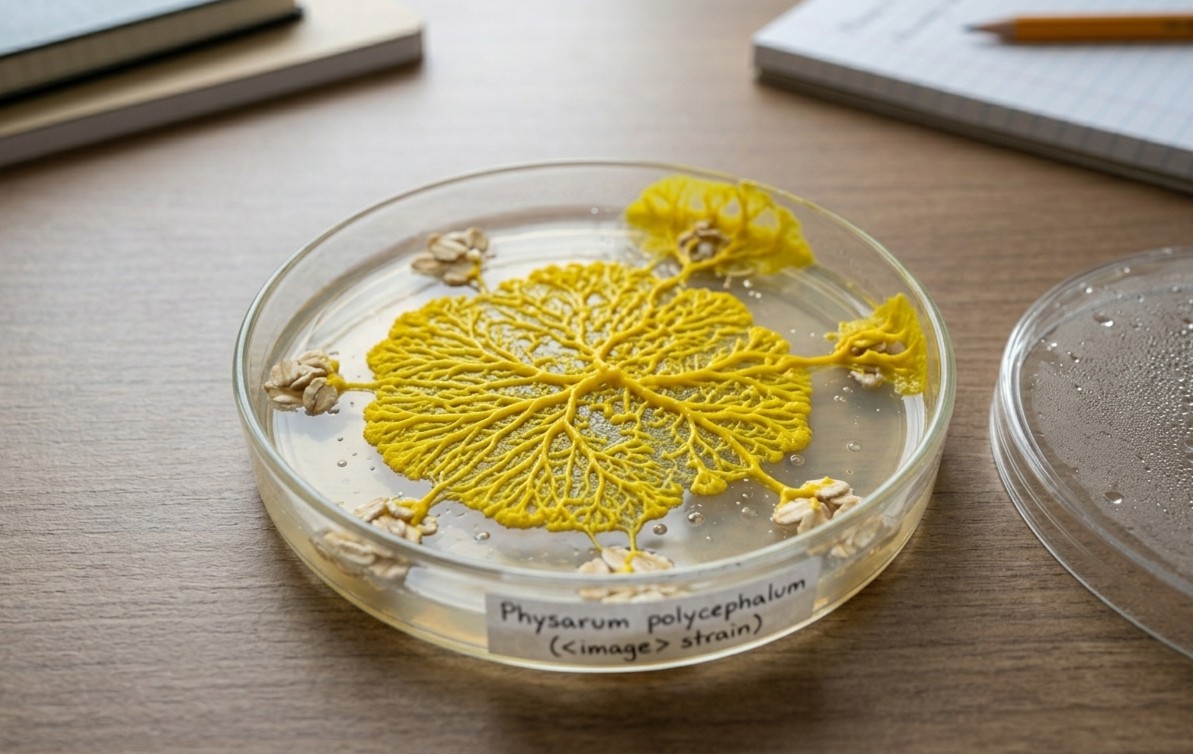
The problem with the word "intelligence"
When scientists say slime mold is "intelligent," they don't mean it sits around pondering philosophy. They mean it can process information from its environment and produce adaptive, often optimal, responses. That distinction matters, because the word "intelligence" carries heavy baggage.
For most of history, intelligence was assumed to require a brain. Plants, fungi, and single-celled organisms were considered passive, reactive, and essentially mechanical. Physarum polycephalum disrupted that assumption more forcefully than perhaps any other organism.
The question isn't really "Is slime mold intelligent?" The better question is: "What does Physarum do, and does our current definition of intelligence account for it?"
What slime mold can actually do
Here is a factual summary of the cognitive-like behaviors documented in peer-reviewed studies:
| Behavior | What it looks like | Key study |
|---|---|---|
| Maze solving | Finds the shortest path between two food sources in a physical maze | Nakagaki et al., Nature, 2000 |
| Network optimization | Creates transport networks comparable in efficiency to human-engineered systems | Tero et al., Science, 2010 |
| Anticipatory behavior | Slows down at regular intervals after repeated exposure to cold, even when the cold stops | Saigusa et al., Physical Review Letters, 2008 |
| Nutritional decision-making | Chooses the optimal ratio of protein to carbohydrates from multiple food sources | Dussutour et al., PNAS, 2010 |
| Risk assessment | Avoids quinine-laced food even when hungry, but accepts it if no alternative exists | Latty and Beekman, 2011 |
| Habituation (a form of learning) | Learns to cross a bridge coated with a repellent (quinine or caffeine) after repeated exposure | Boisseau et al., Proceedings of the Royal Society B, 2016 |
| Memory transfer | A "naive" slime mold absorbs a habituated one and acquires its learned tolerance | Boisseau et al., 2016 |
| Spatial memory | Leaves a trail of slime to mark explored areas and avoids revisiting them | Reid et al., PNAS, 2012 |
Any one of these would be noteworthy. Together, they paint a picture of an organism with far more sophisticated behavior than its simple biology would suggest.
How does it work? The mechanics of brainless decision-making
The key to understanding Physarum intelligence is its tube network. The organism is essentially a giant cell filled with cytoplasm that flows back and forth through a branching system of tubes. This oscillating flow, called shuttle streaming, is driven by rhythmic contractions of the tube walls.
Here's where it gets interesting. The frequency and amplitude of these contractions are affected by local conditions. When part of the organism detects food, the contractions in that region speed up. When part of it encounters something harmful, the contractions slow down. These local changes propagate through the entire tube network as waves of pressure and chemical signals.
The result is that information about the environment is encoded in the physical flow patterns of the cytoplasm. The organism doesn't need a brain to integrate information because the network itself is the information processor.
A useful analogy
Imagine a river delta. Water flows faster through wider channels and slower through narrow ones. Over time, the busy channels erode deeper and the quiet ones silt up. The delta "optimizes" its drainage network without any planning. Physarum does something similar, except it actively controls the process through muscle-like contractions of its tube walls.
The decision-making process, step by step
When Physarum faces a choice between two food sources, the decision unfolds in a predictable sequence:
Exploration
The organism sends out thin exploratory tubes (pseudopods) in all directions. This is the "search" phase, and it's essentially random. The organism has no way of knowing where food is until it contacts it directly or detects chemicals diffusing from it.
Detection
When a pseudopod reaches a food source, local chemical receptors trigger a change in the contraction rhythm. The tubes near the food start pulsing faster and with greater amplitude.
Competition
If two food sources are found, both regions increase their pulsation rate. The relative strength of these signals determines which direction "wins." Richer food sources produce stronger signals.
Commitment
The organism reinforces tubes toward the stronger signal and begins withdrawing protoplasm from tubes leading to weaker signals. This is a gradual process, not an instant switch.
Pruning
Dead-end tubes and inefficient branches are fully reabsorbed. The final network connects food sources through the most efficient pathways.
This entire process takes anywhere from 2 to 24 hours, depending on the complexity of the environment and the distance between food sources.
Memory without a brain
One of the most provocative findings about Physarum is that it appears to have memory. Several types of memory have been documented:
Spatial memory (externalized)
As the organism moves, it leaves behind a trail of extracellular slime. When it encounters this trail later, it avoids it, preferring to explore new territory. In 2012, Chris Reid and colleagues at the University of Sydney showed that this slime trail functions as an external memory, preventing the organism from wasting energy revisiting areas it has already explored.
This is functionally identical to the "avoid revisited nodes" rule used in many computer search algorithms. The organism has independently evolved the same strategy.
Temporal memory (internal)
In 2008, Tetsu Saigusa's team at Hokkaido University exposed Physarum to cold shocks at regular intervals (every 60 minutes, for example). The organism would slow down in response to each shock. After three shocks, they stopped applying the cold. The organism continued to slow down at the expected interval, "anticipating" a shock that never came.
This anticipatory behavior faded over time if the stimulus was not repeated, which is consistent with how memory works in animals with nervous systems. The mechanism appears to involve oscillation patterns in the cytoplasm that "remember" the timing of past events.
Transferred memory
Perhaps the most remarkable experiment came from Audrey Dussutour's team in Toulouse. They habituated a slime mold to ignore a bitter but harmless substance (caffeine). Then they fused this "trained" organism with a naive one that had never encountered caffeine. The fused organism behaved as if it had been trained, crossing the caffeine bridge without hesitation.
The memory, stored in some as-yet-unidentified molecular form, had been physically transferred from one organism to another through cell fusion.
The intelligence debate: three positions
Scientists studying Physarum generally fall into one of three camps regarding the intelligence question:
| Position | Argument | Notable proponents |
|---|---|---|
| Yes, it's intelligent | Intelligence is defined by adaptive, flexible behavior in novel situations. Physarum qualifies. | Andrew Adamatzky, Toshiyuki Nakagaki |
| No, it's sophisticated but not intelligent | Intelligence requires representation, internal models, or at minimum some form of subjective experience. Physarum has none of these. | Many traditional neuroscientists |
| The question is poorly framed | "Intelligence" is a human concept that doesn't map cleanly onto non-neural systems. Better to describe specific capabilities. | Michael Levin, Audrey Dussutour |
The third position is gaining ground. Rather than arguing about labels, many researchers now prefer to describe exactly what Physarum can do and study the mechanisms behind it. Whether you call it intelligence, computation, or adaptive behavior matters less than understanding how a brainless organism achieves results that we normally associate with neural processing.
What slime mold intelligence tells us about intelligence in general
The deeper implication of Physarum research isn't about slime mold at all. It's about the nature of information processing in biological systems.
Brains are one solution to the problem of processing environmental information and producing adaptive responses. But they are not the only solution. Evolution has produced many others:
- Plant root networks make foraging decisions similar to Physarum, exploring soil and reinforcing pathways toward nutrients
- Ant colonies solve optimization problems through pheromone trails, using a mechanism strikingly similar to slime mold tube reinforcement
- Immune systems learn, remember, and make complex decisions about self vs. non-self, all without any neural involvement
- Gene regulatory networks in single cells perform logical operations (AND, OR, NOT gates) that are functionally equivalent to electronic circuits
Physarum polycephalum sits at a fascinating crossroads of all these ideas. It is a single cell that behaves like a network. It has no neurons but processes information. It has no memory organ but remembers. Studying it doesn't just teach us about slime mold. It forces us to reconsider what we mean by sensation, cognition, and the minimum requirements for adaptive behavior.
Further reading
To see slime mold intelligence in action, read about the Tokyo rail experiment, where Physarum replicated a city's entire transit network. For the biological underpinnings, see slime mold biology.