What happens when slime mold revives
A sclerotium is the dried dormant form of Physarum polycephalum. Inside this hard, paper-like shell, the organism has shut down nearly all metabolic activity. Its cytoplasm is dehydrated, its cellular machinery is paused, and it waits for the right conditions to come back to life.
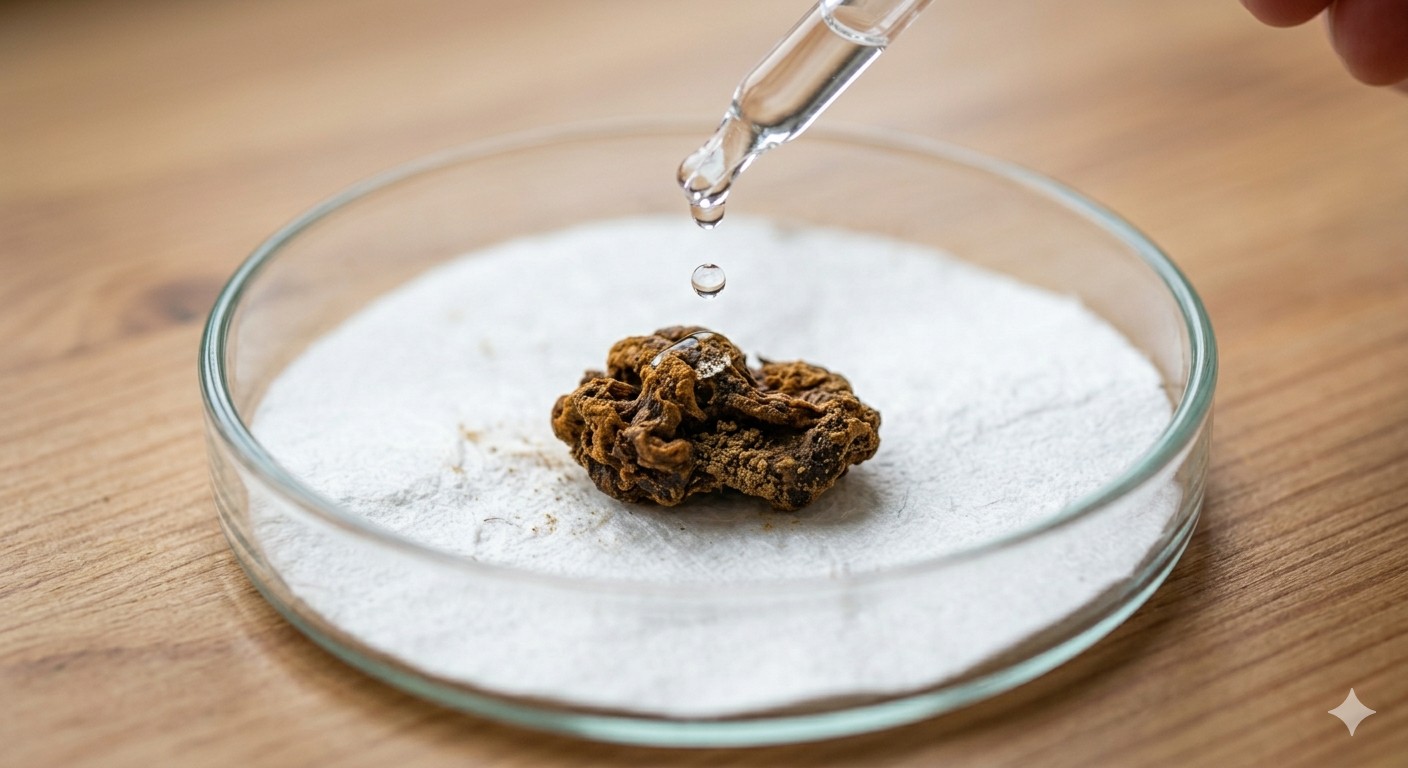
When water and food become available, the sclerotium absorbs moisture, rehydrates its internal structures, restarts cytoplasmic streaming, and eventually sends out new exploratory veins. The entire process typically takes 12 to 48 hours from first contact with water to visible growth.
What you need
- A dried sclerotium (on filter paper, agar, or loose)
- A clean Petri dish (9 cm or larger) or shallow food container
- Plain agar or damp paper towel as substrate
- Rolled oats (non-instant, unflavored)
- Non-chlorinated water (filtered, bottled, or tap water left to sit for 24 hours)
- A spray bottle or pipette
- Aluminum foil or a dark cloth (to block light)
Step-by-step revival process
- Prepare the substrate. Pour a thin layer (2-3 mm) of plain 2% agar into a clean Petri dish and let it solidify. Alternatively, lay a damp paper towel flat in a shallow container. The substrate should be moist but not flooded.
- Place the sclerotium. Set the dried sclerotium (with its filter paper if attached) directly onto the damp surface. If the sclerotium is on filter paper, place it paper-side down so the organism contacts the moisture.
- Add a few drops of water. Using a pipette or spray bottle, gently moisten the sclerotium with 5-10 drops of non-chlorinated water. Do not submerge it. The goal is to start the rehydration process without drowning the organism.
- Place food nearby. Set 2-3 oat flakes about 1-2 cm away from the sclerotium. Not touching it directly. The scent of nearby food encourages the slime mold to wake up and explore.
- Cover and darken. Put the lid on the Petri dish and wrap it in aluminum foil or place it in a dark cupboard. Slime mold prefers darkness during the revival phase.
- Wait patiently. Revival takes time. Check every 6-8 hours, but try not to disturb the setup. Opening the lid frequently causes humidity fluctuations.
Temperature matters
The ideal temperature for revival is 20-25 °C (68-77 °F). Cooler temperatures slow the process significantly. If your room is below 18 °C, the revival may take 2-3 times longer than the timeline below suggests.
Hour-by-hour revival timeline
This timeline assumes room temperature (20-25 °C) and a relatively fresh sclerotium (less than 6 months old). Older sclerotia may take longer at each stage.
| Time | What to expect | What to do |
|---|---|---|
| 0-2 hours | Sclerotium absorbs water. It softens and may darken slightly. No visible movement yet. | Nothing. Leave it alone. |
| 2-6 hours | Color may shift from dark brown toward a muted yellow. Edges may look slightly glossy as rehydration progresses. | Check briefly. If the surface looks dry, add 2-3 more drops of water. |
| 6-12 hours | First signs of life: tiny yellow-orange protrusions or thin veins emerging from the edges of the sclerotium. | Do not touch or move the dish. These early veins are fragile. |
| 12-18 hours | Clear yellow veins extending outward. The organism may begin exploring toward the oat flakes. Cytoplasmic streaming is visible under magnification. | You can check progress but avoid opening the lid more than once. |
| 18-24 hours | Active growth toward food. The slime mold has typically reached the nearest oat flake and started feeding. Color is brightening to vivid yellow. | If it has reached the oats, the revival is successful. You can start normal care. |
| 24-48 hours | Full revival. The organism is actively feeding, growing, and exploring. Network formation is visible. | Resume normal growing and feeding routine. |
Signs of a healthy revival
A successful revival shows these characteristics:
- Color: Bright yellow to golden yellow. A healthy, actively growing Physarum polycephalum has vivid coloring.
- Vein structure: Clear, well-defined veins extending outward from the original sclerotium. The network should look organized, not chaotic.
- Movement toward food: The slime mold should actively grow toward the oat flakes. This directional growth is a strong indicator of healthy metabolic function.
- Cytoplasmic streaming: Under a magnifying glass or microscope, you should see the characteristic pulsing flow of cytoplasm through the veins. This oscillation (approximately every 100 seconds) is the heartbeat of a healthy slime mold.
- Growth rate: A healthy revived culture should cover about 1-3 cm in the first 24 hours after the initial veins appear.
Signs that something is wrong
- No change after 48 hours: The sclerotium may be too old or was stored improperly. See troubleshooting below.
- Dark brown or black veins: This can indicate cell death. Healthy Physarum veins are yellow, not dark.
- Fuzzy white or green growth: This is mold contamination, not slime mold revival. See troubleshooting below.
- Slimy but no structure: If the sclerotium dissolves into a formless paste without developing veins, the cells have likely lost viability.
Troubleshooting revival problems
Problem: No activity after 48 hours
Possible causes and solutions:
- Sclerotium is too old. Viability decreases over time. Sclerotia stored at room temperature for more than 2 years may not revive. Try a fresh sample.
- Temperature too low. Move the dish to a warmer location (22-25 °C) and wait another 24 hours.
- Not enough moisture. Add more water and ensure the substrate stays consistently damp.
- Chlorinated water. Chlorine in tap water can inhibit revival. Switch to filtered or bottled water.
- Sclerotium dried too fast during creation. If the original sclerotium was made by rapid drying (heat, direct sun), the cells may have died rather than entering true dormancy.
Problem: Mold contamination during revival
Mold spores are everywhere, and the warm, moist conditions ideal for slime mold revival are also ideal for mold growth.
- Immediate action: If mold appears near but not on the slime mold, carefully cut away the contaminated section of agar and transfer the slime mold to a clean plate.
- Prevention: Use clean equipment. Wipe Petri dishes with 70% isopropyl alcohol before use. Do not leave the lid open longer than necessary.
- Oat preparation: Some hobbyists briefly microwave oat flakes (10-15 seconds) to reduce surface mold spores before placing them in the dish.
Problem: Partial revival then stalling
The slime mold starts to emerge but then stops growing after a few hours.
- Check humidity: The dish may be too dry. Add water and seal the lid more tightly.
- Move food closer: If the oats are too far away, the weakened organism may not have enough energy to reach them. Place an oat flake within 5 mm of the emerging veins.
- Be patient: Some revivals are slow. A partial start is still a good sign. Give it another 24 hours with optimal conditions before concluding it has failed.
Problem: Slime mold revives but looks pale or weak
- This is normal for the first 24 hours. Freshly revived slime mold is often pale yellow rather than vivid. Color deepens as the organism feeds and strengthens.
- Ensure good food supply. Place several oat flakes nearby. A well-fed slime mold recovers color and vitality within 1-2 days.
- Keep in darkness. Light can slow recovery and bleach the pigments. Keep the dish covered or in a dark space for the first 48 hours.
Revival success rates
Under good conditions, fresh sclerotia (less than 3 months old) revive successfully about 90-95% of the time. Sclerotia stored for 6-12 months have roughly 70-80% success rates. After 2+ years, success drops below 50%, though some remarkably resilient cultures have been revived after much longer periods.
After revival: first 72 hours
Once your slime mold has successfully revived and started feeding, follow these guidelines for the first three days:
- Feed daily. Place 2-3 fresh oat flakes each day to support the recovering organism. Remove old, uneaten oats to prevent contamination.
- Keep humidity high. Mist the inside of the lid lightly if the dish seems to be drying out. The agar or substrate should stay moist.
- Maintain darkness. Keep the culture in a dark or dimly lit area for at least 48-72 hours. This helps the slime mold focus on growth rather than protective responses to light.
- Avoid handling. Do not poke, move, or transfer the slime mold during this period. Let it establish a healthy network before any manipulation.
- Watch for contamination. Check daily for any signs of mold (fuzzy white, green, or black spots). Early detection and removal prevents bigger problems.
After 72 hours with good feeding and conditions, your revived slime mold should be growing vigorously and ready for experiments, maze exploration, or simply enjoying as a fascinating living organism. For long-term care instructions, check our complete growing guide.