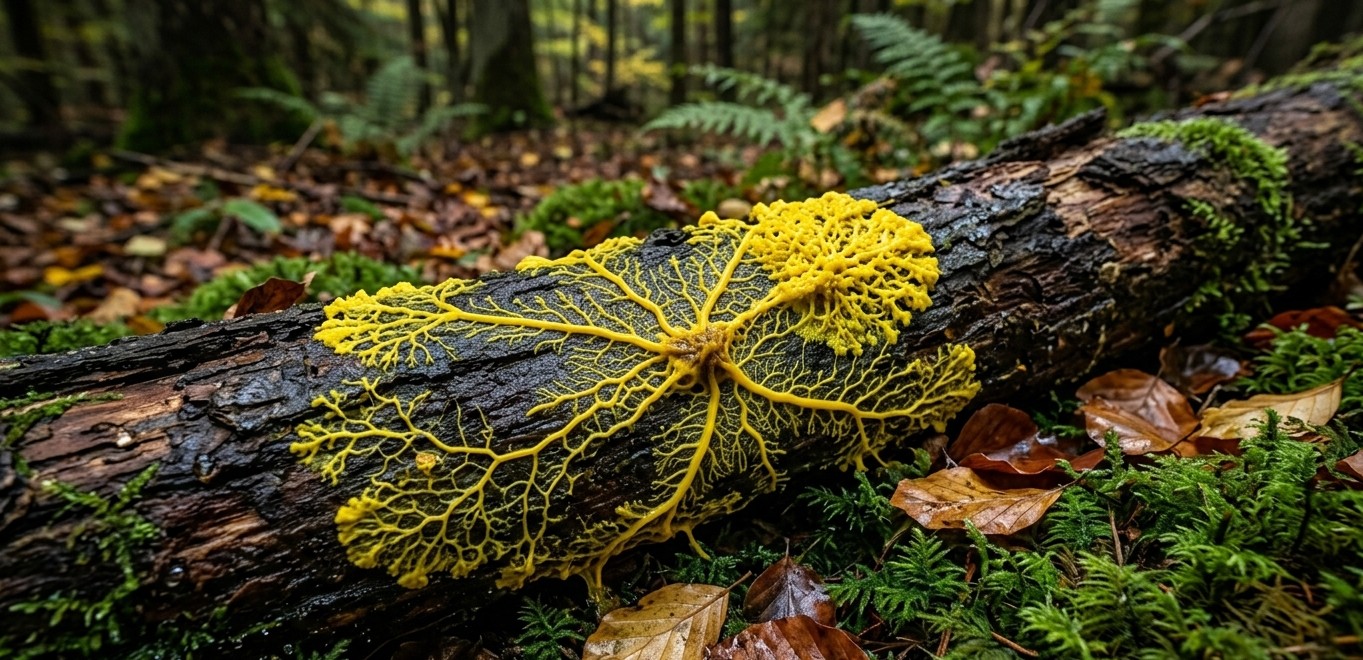
The natural habitat
Slime molds are not rare. They are, however, easy to overlook. Most species spend their active lives in places humans rarely examine: the undersides of fallen logs, the damp layer between leaf litter and soil, the crevices inside rotting stumps. You can walk through a forest full of slime molds and never see one unless you know where to look.
Physarum polycephalum and other myxomycetes need three conditions to thrive:
- Moisture: This is the single most important factor. Slime molds are mostly water. The active plasmodium dries out and dies (or enters dormancy) within hours if humidity drops. You will almost never find active slime molds in dry conditions.
- Decaying organic matter: Slime molds feed on bacteria, yeasts, and fungal spores that colonize decomposing wood and leaf litter. No decay, no food, no slime mold.
- Shade: Most species actively avoid direct sunlight. Bright light triggers sporulation or retreat. Look in shaded, sheltered spots.
Geographic distribution
Myxomycetes are found worldwide. The group is genuinely cosmopolitan, recorded on every continent where researchers have looked (including sub-Antarctic islands). Here is what the distribution looks like by region:
| Region | Species diversity | Best habitats | Notes |
|---|---|---|---|
| Eastern North America | Very high (600+ species) | Appalachian hardwood forests, Great Smoky Mountains | One of the most studied regions; excellent field guides available |
| Western North America | High | Pacific Northwest rainforests, coastal redwood forests | Moist coastal forests are extremely productive |
| Western Europe | High (well-documented) | Atlantic forests (UK, France, Germany), Scandinavian boreal forests | Long research history; many amateur mycology groups active |
| Tropical regions | High but understudied | Cloud forests, tropical montane forests | Many undescribed species likely remain; lowland tropics are surprisingly poor in myxomycetes |
| Australia/New Zealand | Moderate to high | Temperate rainforests (Tasmania, South Island NZ) | Growing research interest; some endemic species |
| East Asia | High | Japanese temperate forests, Chinese cloud forests | Active research community, especially in Japan |
| Arid regions | Low | Desert washes after rain, nivicolous species in alpine snowmelt | Specialized species exist even in deserts, active only during brief wet periods |
An important note: the apparent distribution of myxomycetes largely reflects where researchers have looked. Tropical forests and the Southern Hemisphere are significantly understudied. The true diversity is almost certainly higher than current records suggest.
When to look: seasonal patterns
Slime mold activity follows moisture and temperature cycles. The ideal conditions are rain followed by several days of mild, humid weather.
Temperate climates (most of North America, Europe, East Asia)
| Season | Activity level | What to expect |
|---|---|---|
| Spring (March-May) | Moderate to good | Myxamoebae emerging from spores; early plasmodia forming; nivicolous species active in mountain snowmelt |
| Summer (June-August) | Variable | Good in wet summers; poor in dry ones. Peak diversity in consistently moist regions (Pacific NW, British Isles) |
| Autumn (September-November) | Best | Peak season in most temperate regions. Abundant leaf litter, regular rain, mild temperatures. The most species and the largest plasmodia |
| Winter (December-February) | Low to absent | Dormancy in most regions. Some activity possible in mild maritime climates (coastal UK, Pacific NW, southern Japan) |
The 48-hour rule
Experienced slime mold hunters follow a simple timing rule: go looking 24 to 48 hours after significant rainfall. The first day after rain, moisture has penetrated the wood and leaf litter, triggering dormant organisms to reactivate. By the second day, active plasmodia have had time to grow large enough to be visible. By the third or fourth day, if no more rain comes, many will have retreated or entered dormancy again.
Where to look: a practical field guide
Here are the specific microhabitats where slime molds are most commonly found, ranked by productivity:
The underside of fallen logs
This is the single best place to find slime molds. Roll a partially decayed log and examine the surface that was in contact with the ground. This zone combines moisture, darkness, bacterial food, and physical shelter. Always roll the log back into position afterward to preserve the habitat.
Beneath loose bark
Peel back bark that's already lifting from dead trees. The space between bark and wood is a protected, humid microhabitat ideal for small plasmodia and mature sporangia.
Inside hollow stumps and logs
The interior surfaces of hollow stumps often host slime molds. Bring a flashlight and look at the inner walls. The darkness and consistent humidity make these excellent habitats.
Leaf litter layers
Gently separate the layers of leaf litter on the forest floor, especially in deciduous forests during autumn. Slime molds often grow in the middle layers where moisture is trapped between decomposing leaves.
Wood chip mulch
Garden mulch made from wood chips is a surprisingly productive slime mold habitat, especially in its first year. The combination of fresh organic matter, regular watering, and bacterial colonization creates ideal conditions. The common "dog vomit" slime mold (Fuligo septica) frequently appears in mulched garden beds.
Compost piles
Undisturbed compost heaps, especially those not regularly turned, can harbor several species of myxomycetes.
Identifying common species
There are roughly 1,000 described species of myxomycetes worldwide. Most require microscopic examination of spore characteristics for definitive identification. However, several common species can be recognized in the field:
| Species | Common name | Active stage appearance | Fruiting body appearance | Habitat |
|---|---|---|---|---|
| Physarum polycephalum | "The blob" | Bright yellow network with visible veins | Small dark sporangia on stalks | Decaying logs, leaf litter |
| Fuligo septica | Dog vomit slime mold | Large (up to 20 cm) yellow-white foamy mass | Darkens to brown-tan crusty mass | Mulch, garden beds, logs |
| Lycogala epidendrum | Wolf's milk | Rarely seen in plasmodial stage | Pink-red spheres (1-1.5 cm) on wood, turning gray-brown | Dead hardwood logs |
| Stemonitis spp. | Chocolate tube slime | White or pale plasmodium | Dense clusters of tall brown sporangia resembling tiny bottle brushes | Dead wood, especially oak |
| Arcyria spp. | Carnival candy slime | Rarely seen | Bright red, orange, or yellow tufted sporangia | Dead wood |
| Ceratiomyxa fruticulosa | Coral slime | Not applicable (different biology) | White, finger-like projections on wood | Moist dead wood |
| Trichia spp. | - | Translucent plasmodium | Small yellow-orange cups or spheres | Dead wood |
Plasmodium vs. fruiting body
Most field observations are of fruiting bodies (sporangia), not active plasmodia. The plasmodial stage is short-lived and often hidden. Sporangia, by contrast, can persist for weeks or months and are easier to spot. If you find sporangia, active plasmodia are probably nearby but may be hidden beneath bark or inside wood.
How to tell slime molds from fungi
In the field, slime molds are frequently confused with fungi. Here are the key differences visible without a microscope:
- Movement: If it's visibly moving or has changed position between visits, it's a slime mold. Fungi don't relocate.
- Texture when active: Active slime mold plasmodia feel wet, slimy, and gelatinous. Most fungi feel firm or corky.
- Network pattern: Many slime molds display a branching vein-like network that is quite unlike any fungal growth pattern.
- Speed of appearance: Slime molds can appear overnight, literally growing from invisible to several centimeters in 12 hours. Most fungi develop more slowly.
For a detailed scientific comparison, see our article on slime mold vs. fungi.
Collecting slime molds
If you want to bring specimens home for observation or cultivation, here are some guidelines:
- Active plasmodia: Scoop up a small portion (1-2 cm) along with its substrate (piece of bark, chunk of wood). Place it in a sealed container with a damp paper towel to maintain humidity. Get it home within a few hours and transfer to an agar plate or moist container.
- Sporangia: These are easier to collect and transport. Cut or break off the piece of wood bearing the sporangia and store in a paper bag (not plastic, which traps moisture and promotes mold growth). Sporangia can be stored dry for years for later identification or spore germination.
- Ethics and legality: Slime molds are not protected species in most jurisdictions. In national parks and nature reserves, collecting may require a permit. Take only what you need, and always leave the majority of any population undisturbed.
Photography tips
Slime mold photography has become a popular niche in nature photography. Some tips for getting good shots in the field:
- A macro lens (or clip-on macro for smartphones) is almost essential. Most sporangia are 1-5 mm tall.
- Use a tripod or stabilize your camera on the ground. Low light conditions in forest understory demand long exposures.
- Morning dew often adds photogenic water droplets to sporangia.
- Focus stacking (combining multiple images at different focus distances) dramatically improves depth of field for tiny subjects.
- A small LED flashlight can add directional light that reveals the translucency and texture of plasmodia and sporangia.
For more on photographing slime molds, see our slime mold photography guide.
Start looking
The best way to find slime molds is to develop a habit of looking. Check the same fallen log every week after rain. Flip the same pieces of bark. Over a few seasons, you'll develop an intuition for where and when slime molds appear in your local area. It's one of those pursuits that rewards patience and attention far more than expensive equipment.