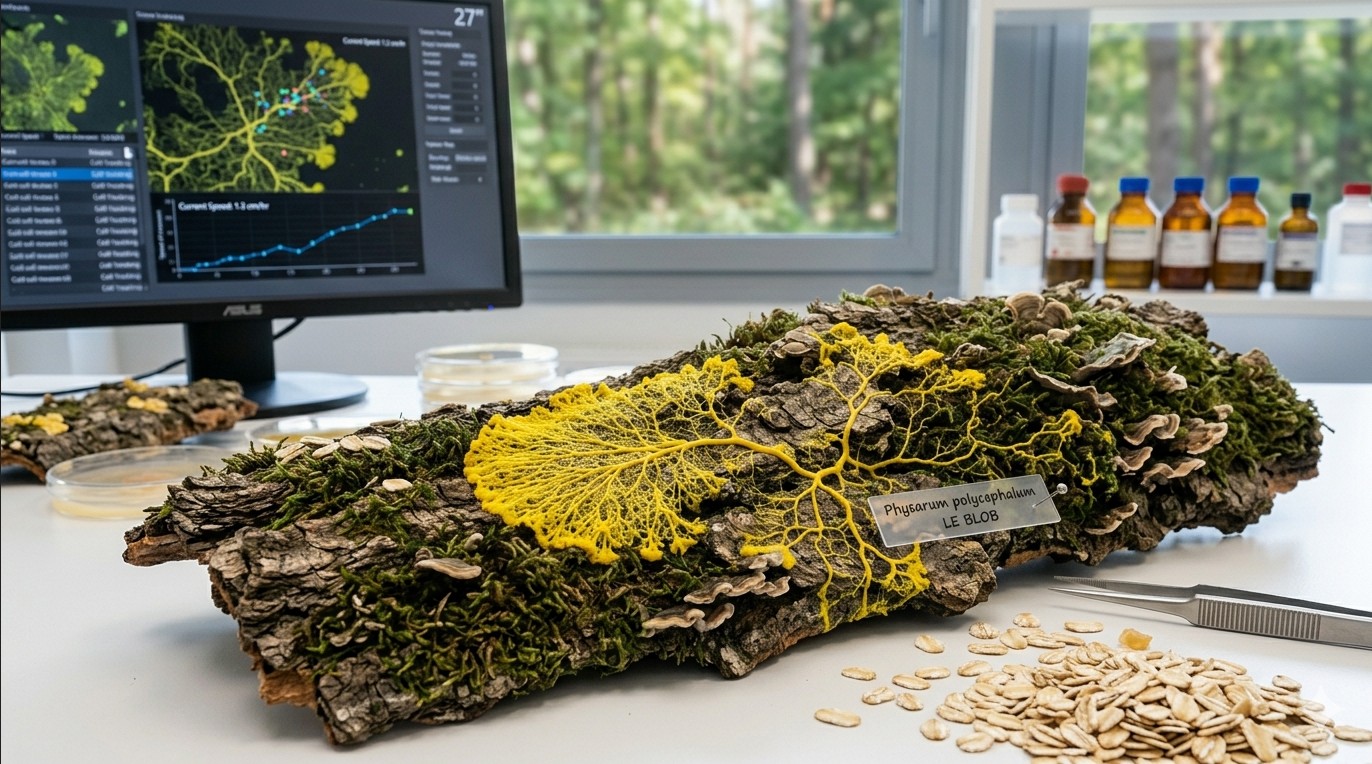
A life cycle like no other
If you only know Physarum polycephalum as the bright yellow network that crawls across agar in lab experiments, you're seeing just one stage of a life cycle that includes at least five dramatically different forms. The organism can be a spore, a microscopic amoeba, a swimming flagellated cell, a giant multinucleated plasmodium, or a forest of spore-bearing structures called sporangia.
No other well-known organism undergoes such radical transformations. Each stage looks so different from the others that early biologists sometimes classified them as separate species.
The complete life cycle, stage by stage
Spore
The cycle begins with a spore: a tough, dormant cell about 10 micrometers in diameter, protected by a thick wall. Spores can survive extreme conditions (desiccation, UV radiation, temperature extremes) for years, possibly decades. They are dispersed by wind, water, or the movements of small animals.
Myxamoeba
When conditions are favorable (adequate moisture, moderate temperature, presence of food), a spore germinates and releases a tiny amoeba-like cell called a myxamoeba. This cell is haploid (one set of chromosomes) and feeds on bacteria by engulfing them, just like a standard amoeba. Myxamoebae can divide and multiply on their own, building up a population.
Flagellated swarm cell
If the myxamoeba encounters water (a thin film of moisture on a surface, or a puddle), it can reversibly transform into a flagellated cell with two whip-like tails. This "swarm cell" can swim freely in water, allowing the organism to disperse further. When conditions dry out, the swarm cell reverts to the amoeba form. This transformation can happen repeatedly.
Sexual fusion (syngamy)
When two compatible myxamoebae (or swarm cells) meet, they fuse together. This is true sexual reproduction: two haploid cells combine their genetic material to form a single diploid cell called a zygote. Compatibility is determined by the organism's mating type system (more on this below).
Plasmodium
The zygote begins to grow, but instead of dividing into separate cells, the nucleus divides repeatedly without the cell itself splitting. The result is a single giant cell containing millions of nuclei, all sharing one continuous cytoplasm. This is the plasmodium: the bright yellow, vein-like network that most people recognize as "the blob." A single plasmodium can grow to cover an area of several square meters.
Sporulation
When conditions deteriorate (starvation, excessive light, or desiccation), the plasmodium transforms into sporangia. The entire organism reorganizes itself into dozens or hundreds of tiny stalked structures, each topped by a spore-bearing capsule. Inside these capsules, meiosis occurs: the diploid nuclei divide to produce haploid spores, completing the cycle.
720+ mating types: why?
Most organisms that reproduce sexually have two sexes. Physarum polycephalum has over 720. These are not sexes in the traditional sense (there is no male or female) but rather "mating types" determined by genetic loci that control compatibility.
The system works through three independent genetic loci, each with multiple alleles:
| Locus | Number of known alleles | Function |
|---|---|---|
| matA | 16+ | Controls cell fusion (plasmogamy) |
| matB | 15+ | Controls nuclear fusion (karyogamy) |
| matC | 3+ | Controls plasmodium development |
For successful mating, two cells must differ at all three loci. With 16 x 15 x 3 = 720 possible combinations, the probability that any two random cells in a population will be compatible is extremely high (roughly 97-99%). This is the whole point of having so many mating types: it virtually guarantees that any individual can mate with almost any other individual it encounters.
Why not just have two sexes?
In a two-sex system, any individual can only mate with 50% of the population. In a 720-type system, an individual can mate with about 99% of the population. This dramatically increases the chances of finding a compatible partner, which is especially useful for an organism that can't move quickly and relies on random encounters between microscopic cells.
Sexual vs. asexual reproduction
Physarum actually has multiple reproductive strategies, and it uses them depending on circumstances:
| Strategy | When it happens | Genetic result |
|---|---|---|
| Sexual (syngamy + sporulation) | When compatible cells meet and conditions later trigger sporulation | Genetic recombination; offspring are genetically unique |
| Asexual (apogamic sporulation) | Some strains can produce spores without prior mating | Clones of the parent; no genetic variation |
| Fragmentation | The plasmodium can be physically divided, and each piece regenerates into a complete organism | Clones of the parent |
| Sclerotium and revival | Not reproduction per se, but dormancy allows the same individual to survive indefinitely | Same individual; no reproduction occurs |
In laboratory settings, most Physarum cultures are maintained through fragmentation. Researchers (and hobbyists) simply cut the plasmodium and place pieces on fresh agar. This is the simplest way to propagate the organism, but it produces genetically identical clones. Many lab strains have been propagated this way for decades.
Sporulation: the transformation in detail
Sporulation is the most visually dramatic event in the Physarum life cycle. A bright yellow, sprawling plasmodium transforms over the course of 12 to 24 hours into a cluster of tiny, dark-colored, stalked structures.
The process follows a predictable sequence:
- Aggregation (0-2 hours): The plasmodium stops foraging and begins retracting. The network consolidates into a series of dense mounds.
- Stalk formation (2-6 hours): Each mound extends upward, forming a thin stalk. The organism is literally building a structure, using hardened slime and dead cells as construction material.
- Head formation (6-12 hours): At the top of each stalk, the remaining protoplasm forms a spherical or pear-shaped capsule (the sporangium head).
- Meiosis (12-18 hours): Inside the capsule, the diploid nuclei undergo meiosis, producing haploid cells that develop thick protective walls and become spores.
- Maturation (18-24 hours): The sporangia dry out and darken. The capsule walls become brittle. The spores are ready for dispersal.
A single plasmodium can produce hundreds of sporangia, each containing thousands of spores. The total spore output from one large plasmodium can exceed a million.
What triggers sporulation?
In the wild, sporulation is typically triggered by environmental stress. The most common triggers are:
- Starvation: When food runs out, sporulation is the default survival strategy
- Light exposure: Sustained exposure to blue or white light strongly promotes sporulation (this is why lab cultures are kept in the dark)
- Desiccation: Drying conditions can trigger either sporulation or sclerotium formation, depending on how rapidly moisture is lost
- Temperature changes: A sudden shift from warm to cool conditions can induce sporulation in some strains
In laboratory settings, researchers can reliably induce sporulation by starving the organism for 3-5 days and then exposing it to light. The combination of nutritional stress and light is the most consistent trigger.
For hobbyists: avoiding unwanted sporulation
If you're growing slime mold at home and want to keep it in its active plasmodium stage, follow three rules: feed it regularly (every 1-2 days), keep it in the dark, and maintain humidity. A well-fed organism in a dark, moist environment will almost never sporulate spontaneously.
Spore dispersal and survival
Once mature, sporangia release their spores primarily through mechanical breakage. Wind, rain, or contact with passing animals can crack open the brittle capsule walls. Some species have specialized structures (capillitium) inside the capsule that twist and writhe as they absorb and release moisture, helping to push spores out.
Spores are astonishingly tough. Studies have shown they can survive:
- Complete desiccation for years (some viable spores have been recovered from herbarium specimens over 50 years old)
- Temperatures from below freezing to over 60 C (briefly)
- UV radiation exposure that would kill most cells
- Passage through the digestive tracts of small invertebrates
This durability makes spores effective long-distance dispersal units. A spore produced in a European forest can, in theory, travel by wind to another continent and germinate years later when conditions are right.
The evolutionary puzzle
The Physarum life cycle raises an interesting evolutionary question: why maintain such complexity? The organism can reproduce by simple fragmentation, which is quick and requires no partner. Why bother with the elaborate sexual cycle involving mating types, cell fusion, and sporulation?
The most likely answer is genetic diversity. Fragmentation produces clones, which are genetically identical to the parent. If the environment changes (a new pathogen appears, food sources shift, temperatures change), clones are all equally vulnerable. Sexual reproduction shuffles genes, producing offspring with different combinations of traits. Some of these may be better adapted to new conditions.
The 720+ mating type system amplifies this advantage by ensuring that mating is almost always possible and that inbreeding is rare. For a slow-moving, single-celled organism that relies on chance encounters, this system is an elegant solution to the problem of maintaining genetic diversity in a population.
Life cycle comparison
To see how the plasmodium stage fits into the organism's broader biology, read about slime mold as a single giant cell. For what happens when the organism enters dormancy instead of sporulating, see slime mold dormancy and sclerotium.