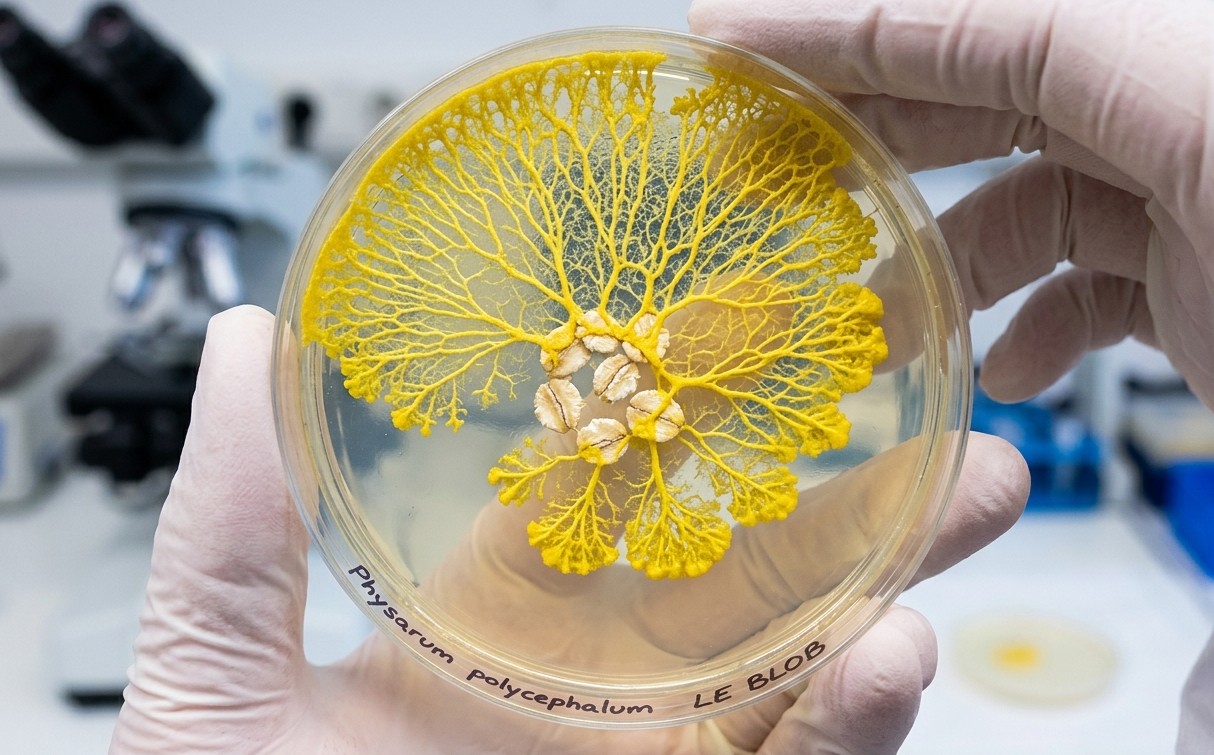
Imagine an organism that can navigate a maze, design efficient transport networks, and learn from experience. Now imagine it does all of this without a brain, without a single neuron, without any nervous system at all. This is Physarum polycephalum, the slime mold that has turned biology upside down and forced scientists to rethink what intelligence really means.
Not an Animal, Not a Plant, Not a Fungus
For centuries, naturalists struggled to classify slime molds. They grow in damp, dark environments like fungi. They move and consume food like animals. They produce spores like plants. And yet, they belong to none of these kingdoms.
Physarum polycephalum is a myxomycete, a type of organism classified within the kingdom Protista. Protists are eukaryotic organisms (their cells contain a nucleus) that do not fit neatly into the animal, plant, or fungal categories. Slime mold occupies its own branch on the tree of life, a position that reflects just how unique its biology truly is.
The scientific name itself tells a story: Physarum means "bladder" or "bellows" in Greek, while polycephalum translates to "many-headed." It is a fitting description for an organism that extends in every direction at once, creating a sprawling network of interconnected veins.
Quick Definition
Physarum polycephalum is a single-celled, multinucleate protist belonging to the myxomycete group. Despite having no brain or nervous system, it exhibits behaviors typically associated with complex organisms: learning, memory, and optimized decision-making.
One Cell, Billions of Nuclei
Perhaps the most astonishing fact about slime mold is its cellular structure. A specimen the size of your hand, or even the size of a table, is technically a single cell. Inside that cell, there are no internal walls separating compartments. Instead, a continuous cytoplasm flows freely throughout the entire body, carrying with it millions or even billions of nuclei.
This type of structure is called a syncytium. In most complex organisms, cells are individually wrapped in membranes and organized into tissues and organs. Slime mold takes a radically different approach: one membrane, one shared cytoplasm, and countless nuclei all working together without any central coordination.
To learn more about this remarkable architecture, see our full article on slime mold's single-cell biology.
What Slime Mold Is Not
Before going further, it is worth clearing up some common misconceptions:
- It is not a fungus, even though it often grows in the same habitats as mushrooms and molds.
- It is not dangerous to humans, pets, or garden plants.
- It is not a parasite. It does not colonize living organisms. It feeds on bacteria, fungal spores, and decaying organic matter in its environment.
- It is not a true mold, despite what the common name suggests. "Slime mold" is a historical term that stuck long after scientists reclassified these organisms.
- It is not microscopic. A single plasmodium can grow to cover several square meters.
Slime Mold Compared to Other Life Forms
Understanding where slime mold fits in the living world becomes much clearer when you compare it side by side with other types of organisms.
| Characteristic | Slime Mold | Fungus | Bacterium | Animal |
|---|---|---|---|---|
| Cell type | Eukaryotic | Eukaryotic | Prokaryotic | Eukaryotic |
| Number of cells | 1 giant cell | Multicellular | 1 cell | Multicellular |
| Nuclei per cell | Millions to billions | 1-2 per cell | No true nucleus | 1 per cell |
| Can move? | Yes | No | Some | Yes |
| Photosynthesis? | No | No | Some | No |
| Feeding method | Phagocytosis | External absorption | Absorption | Ingestion |
| Nervous system | None | None | None | Yes (usually) |
| Can learn? | Yes | No | No | Yes (usually) |
| Kingdom | Protista | Fungi | Bacteria | Animalia |
The Life Cycle: From Spore to Plasmodium
Slime mold goes through several distinct life stages, each with its own characteristics:
1. Spore. The life cycle begins with a microscopic spore, typically 8 to 12 micrometers in diameter. Spores are hardy and can survive unfavorable conditions for years.
2. Amoeba. When conditions are right (sufficient moisture, suitable temperature), a spore germinates and releases a tiny amoeba-like cell. At this stage, the organism is truly microscopic.
3. Swarm cell. In wet environments, the amoeba can develop flagella (tiny whip-like appendages) and become a free-swimming swarm cell.
4. Zygote and young plasmodium. Two compatible cells fuse to form a zygote. This zygote begins dividing its nucleus without dividing its cell body, gradually forming a small plasmodium.
5. Mature plasmodium. This is the stage most people recognize: a bright yellow, vein-like network that can grow to impressive sizes. The plasmodium moves, feeds, and exhibits all the behaviors that have made slime mold famous.
6. Sclerotium (dormancy). When conditions become harsh (drought, cold, lack of food), the plasmodium can dry itself into a dormant form called a sclerotium. It can remain in this state for months or even years and revive when conditions improve.
7. Fruiting bodies. Under certain conditions, the plasmodium transforms into stalked fruiting bodies that release spores, completing the cycle.
Dormancy Is Not Death
A sclerotium that has been dormant for two years can be reactivated with a few drops of water and a food source. The organism picks up where it left off, retaining information about substances it encountered before entering dormancy.
Why Scientists Study Slime Mold
The scientific interest in Physarum polycephalum has exploded since the early 2000s, driven by a series of groundbreaking experiments.
In 2000, Japanese researcher Toshiyuki Nakagaki published a paper showing that slime mold could find the shortest path through a maze. This was the moment slime mold went from being a biological curiosity to a serious subject of research into unconventional computing and distributed intelligence.
British computer scientist Andrew Adamatzky pushed the boundaries further, demonstrating that slime mold could be used as a biological computer. His work showed that networks formed by Physarum could solve computational problems, model transport networks, and even perform logical operations.
French biologist Audrey Dussutour at CNRS made headlines in 2016 by demonstrating that slime mold can learn through habituation and, remarkably, that this learned information can be transferred from one organism to another through cell fusion. Her research established that memory does not require a nervous system.
Today, research labs in Japan, the UK, France, and the United States explore applications that range from optimization algorithms in computer science to targeted drug delivery in medicine, urban planning, and robotics.
Where Slime Mold Lives in the Wild
In nature, Physarum polycephalum thrives in temperate deciduous forests. It favors:
- Decaying logs and leaf litter on the forest floor
- The underside of bark on dead or dying trees
- Moist, shaded areas with temperatures between 19 and 25 degrees Celsius
- Environments rich in bacteria and fungal spores, which serve as its food
Slime mold is found on every continent except Antarctica, though it tends to be most abundant in temperate regions with regular rainfall. Most people have walked past slime mold without ever noticing it. Only during periods of active growth, when it emerges as a bright yellow or orange mass, does it become visible to the casual observer.
A Name That Stuck
In English-speaking countries, the common name "slime mold" has been in use since at least the 19th century. It is somewhat misleading: the organism is not slimy in the way one might expect, and it is definitely not a mold. The French nickname "le blob," popularized by Audrey Dussutour, references the 1958 science fiction film The Blob, in which a gelatinous alien engulfs everything in its path. The visual resemblance is undeniable, though the real organism is considerably less menacing.
Whatever you call it, Physarum polycephalum remains one of the most fascinating organisms on Earth: a window into forms of intelligence and adaptation that challenge everything we thought we knew about what it takes to be alive.
Explore Further
Discover the full history of slime mold research, or dive into our complete fact sheet for a data-rich overview of this extraordinary organism.