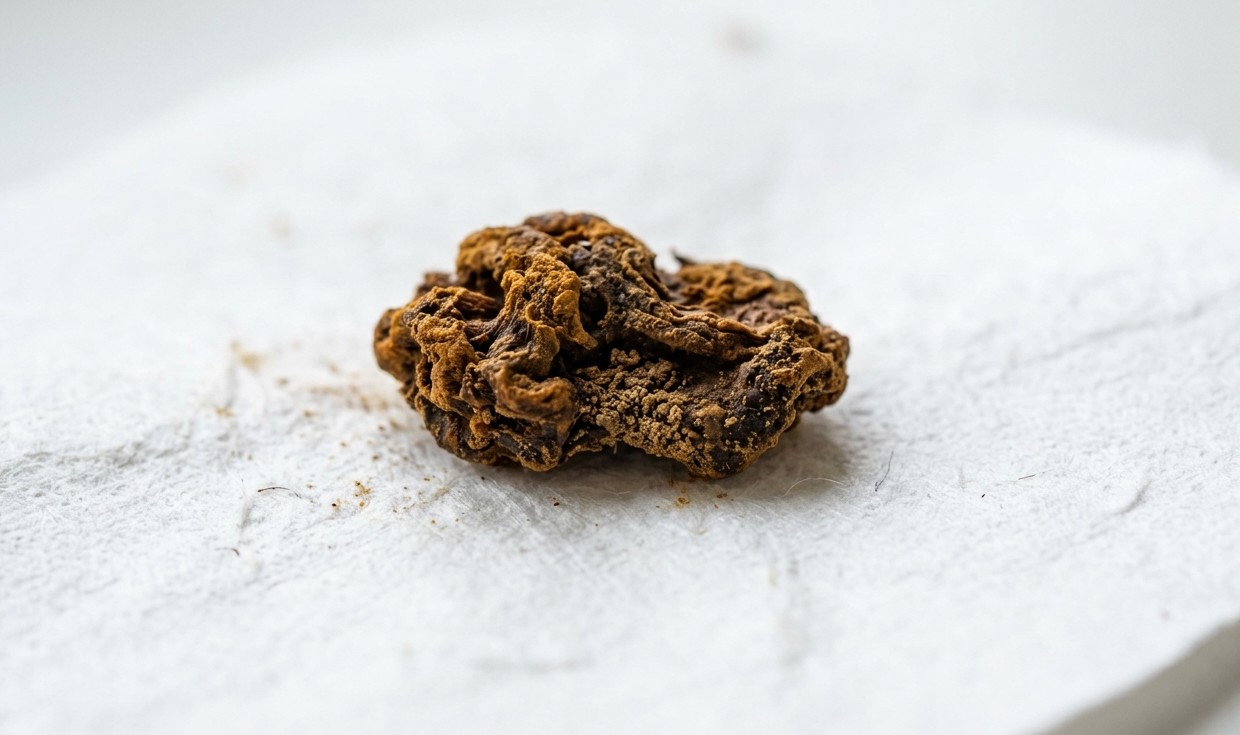
What is a sclerotium?
A sclerotium (plural: sclerotia) is the dormant form of a slime mold plasmodium. When the active, flowing organism encounters desiccation, starvation, cold, or other unfavorable conditions, it undergoes a controlled dehydration process. The result is a hard, dry, irregularly shaped structure that retains the organism's basic network pattern but contains almost no water.
Think of it as biological freeze-drying, except the organism does it to itself, deliberately, and can reverse it.
The sclerotium is not dead tissue. It is a living organism in suspended animation. All the nuclei remain intact, the cellular machinery is preserved, and the organism retains its genetic identity. It's simply waiting for conditions to improve.
How the organism enters dormancy
The transition from active plasmodium to sclerotium follows a specific sequence:
Environmental trigger detected
The organism detects unfavorable conditions: drying substrate, lack of food, cold temperatures, or excessive light. Chemical signals begin propagating through the tube network.
Cytoplasmic streaming slows
The rhythmic contractions that drive shuttle streaming begin to decrease in frequency and amplitude. Flow through the network gradually reduces.
Water expulsion
The organism actively pumps water out of its cells. Intracellular water content drops from roughly 85-90% to below 15%. This is not passive drying; it is a controlled biochemical process.
Protective compounds accumulate
As dehydration proceeds, the organism produces trehalose (a sugar that protects cellular structures during drying) and various stress proteins. These molecules stabilize membranes and proteins that would otherwise be destroyed by water loss.
Hardening
The outer surface hardens into a protective crust. The internal structures consolidate. Shuttle streaming stops completely. The sclerotium is formed.
The entire process takes between 6 and 48 hours, depending on how quickly conditions deteriorate. Gradual drying produces better-quality sclerotia than sudden desiccation, because the organism has more time to synthesize protective compounds.
Sclerotium vs. sporulation
Both sclerotia and sporangia are responses to environmental stress, but they serve different purposes. Sporulation is reproductive: the organism produces spores and effectively "dies" as a plasmodium. Sclerotium formation is about individual survival: the same organism resumes activity when conditions improve. If drying is gradual, the organism tends to form sclerotia. If starvation is combined with light exposure, it tends to sporulate.
What the sclerotium can survive
The dormant sclerotium is remarkably tough compared to the delicate, moisture-dependent plasmodium:
| Stress factor | Active plasmodium tolerance | Sclerotium tolerance |
|---|---|---|
| Desiccation | Dies within hours if humidity drops below ~70% | Survives years in completely dry conditions |
| Cold | Enters dormancy below ~10 C; dies below freezing | Survives temperatures well below 0 C |
| Heat | Dies above ~35 C | Survives brief exposure to 50-60 C |
| UV radiation | Damaged within minutes of direct exposure | Tolerates moderate UV exposure |
| Starvation | Sporulates or dies within days | No metabolism; can wait indefinitely |
| Mechanical damage | Easily torn (though it regenerates) | Brittle but can be broken into pieces, each viable |
The key to this resilience is the trehalose sugar that accumulates during sclerotium formation. Trehalose forms a glass-like matrix around cellular structures, physically preventing them from collapsing as water is removed. This same sugar is found in tardigrades, brine shrimp, and resurrection plants, all organisms famous for surviving extreme dehydration.
How long can a sclerotium survive?
This is a question without a definitive answer. Published studies have successfully revived sclerotia after 2-3 years of storage with high reliability. Anecdotal reports from mycologists describe successful revivals after 5 or more years. Some researchers believe that sclerotia stored under optimal conditions (cool, dark, dry) could remain viable for decades, but systematic long-term studies are lacking.
The practical answer for hobbyists: if you store a sclerotium properly, you can confidently expect it to remain viable for at least 1-2 years. Many people report success after longer periods.
Reviving a sclerotium: step by step
Bringing a sclerotium back to life is straightforward, but a few details matter:
Prepare the substrate
Pour a fresh agar plate (2% plain agar in distilled water) or prepare a damp paper towel in a clean container. The surface must be moist but not flooded.
Place the sclerotium
Lay the dried sclerotium directly on the moist surface. If it has been stored on filter paper, you can place the entire piece of paper on the agar; no need to peel the sclerotium off.
Add food
Place a small piece of oat flake within 1-2 cm of the sclerotium. This gives the organism an immediate food source as it reactivates.
Cover and wait
Close the container and place it in a dark location at room temperature (20-25 C). Do not open the container during the first 12-24 hours; the organism needs stable humidity to rehydrate.
Watch for signs of life
Within 12 to 48 hours, the sclerotium should begin to soften, change color (becoming brighter yellow), and show the first signs of cytoplasmic streaming. Within 24-72 hours, you should see active growth toward the oat flake.
For a more detailed guide with troubleshooting tips, see our sclerotium revival guide.
What happens during revival
The reactivation process is essentially the reverse of dormancy formation:
- Rehydration (0-6 hours): Water is absorbed through the outer surface. The trehalose glass matrix dissolves, releasing cellular structures. Membranes re-form their normal fluid configuration.
- Metabolic restart (6-12 hours): Enzymes reactivate. ATP production resumes. The organism begins to metabolize stored reserves.
- Streaming resumes (12-24 hours): Cytoplasmic streaming restarts, initially as weak, irregular pulses that gradually strengthen and become rhythmic.
- Growth and exploration (24-48 hours): The organism extends pseudopods, begins exploring its environment, and starts feeding if food is present.
Interestingly, research suggests that revived organisms "remember" conditions from before dormancy. In 2016, Audrey Dussutour's team showed that habituated behaviors (learned tolerance to repellent substances) survived the sclerotium stage: the organism woke up with its training intact.
Storing sclerotia: best practices
If you want to store slime mold for later use, creating a high-quality sclerotium is the best approach. Here are the key factors:
| Factor | Optimal condition | Why it matters |
|---|---|---|
| Drying speed | Slow (24-48 hours) | Gives the organism time to produce protective compounds |
| Storage substrate | Clean filter paper or parchment | Non-reactive, allows the sclerotium to dry flat |
| Storage temperature | Cool (4-15 C), stable | Slows any residual metabolism; prevents degradation |
| Storage humidity | Low (below 30% relative humidity) | Prevents premature reactivation or mold growth |
| Light exposure | Complete darkness | Light can degrade proteins and DNA over time |
| Container | Sealed envelope or bag with desiccant packet | Maintains dry conditions; protects from physical damage |
The fridge method
Many experienced growers store sclerotia in a sealed plastic bag with a small silica gel packet, placed in the refrigerator (not freezer). The combination of cool temperature, low humidity, and darkness provides near-optimal long-term storage conditions. Just make sure the sclerotium is fully dried before sealing the bag, or moisture will cause mold to grow on it.
Creating a sclerotium on purpose
To intentionally put your slime mold into dormancy:
- Transfer to filter paper: Move a small piece of active plasmodium onto a clean, dry piece of filter paper or parchment paper placed on a plain agar plate.
- Feed lightly: Give it one last small meal (a single oat flake) so it's not starving when dormancy begins.
- Stop feeding: After it consumes the food, do not add more.
- Allow slow drying: Leave the container slightly open (or poke a few holes in the lid) so moisture gradually escapes over 24-48 hours. Do not use a fan or heater to speed this up.
- Wait: The organism will gradually stop moving, change from bright yellow to a duller orange-brown, and harden onto the filter paper.
- Store: Once completely dry and hard (usually 2-3 days after the process starts), transfer the filter paper with the sclerotium to your chosen storage container.
For more storage options and techniques, see our storing slime mold guide.
Practical implications
The sclerotium stage is not just a biological curiosity. It has real practical significance:
- Education: Schools and universities can order sclerotia by mail and revive them in the classroom, making Physarum one of the most accessible experimental organisms for biology education.
- Research: Laboratories maintain strain libraries as dried sclerotia, allowing decades of research on genetically identical organisms.
- Citizen science: The CNRS "blob" experiment sent sclerotia to thousands of French households in 2022, relying entirely on the organism's ability to survive postal delivery and home revival.
- Hobbyist culture: Online communities ship sclerotia worldwide. The organism's ability to survive in an envelope for weeks makes international exchange straightforward.
Without the sclerotium stage, Physarum polycephalum would be far less useful as a research and educational organism. Its ability to pause and resume its own biology on demand is one of its most remarkable and practically valuable traits.
Related articles
For a step-by-step revival guide, see reviving a slime mold sclerotium. To understand what happens when the organism takes the other path (reproduction instead of dormancy), read about slime mold reproduction.