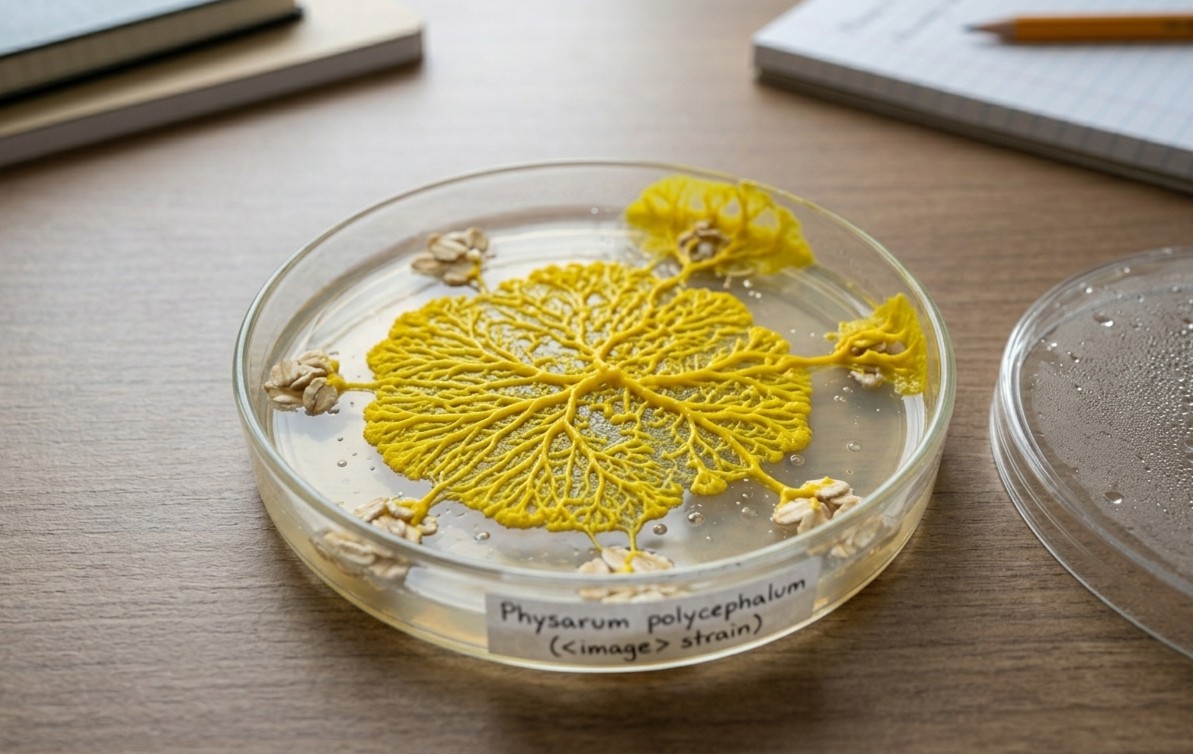
A maze-solving organism
The story begins in the year 2000 at the Bio-Mimetic Control Research Center in Nagoya, Japan. Toshiyuki Nakagaki and his colleagues placed a sample of Physarum polycephalum inside a simple plastic maze. They put food (oat flakes) at two separate exits and let the organism do what it does best: explore.
Within hours, the slime mold had spread through every corridor of the maze. Then something remarkable happened. The organism began pruning its own network, withdrawing protoplasm from dead-end corridors and reinforcing only the tubes connecting the two food sources. After about a day, a single thick tube remained, tracing the shortest path through the maze.
The paper, published in Nature on September 28, 2000, was titled "Maze-solving by an amoeboid organism." It was just 500 words long. Its impact was enormous.
Key finding from the 2000 paper
Physarum polycephalum doesn't just find a path through a maze. It finds the shortest path. And it does this with no brain, no nervous system, and no central control whatsoever. The organism achieves through biochemistry what computers solve through algorithms.
The methodology behind the maze experiment
Nakagaki's experimental design was elegant in its simplicity:
- Maze construction: Standard plastic mazes were used, roughly 30 x 30 mm in size, with multiple possible routes between entry and exit points.
- Organism placement: A piece of plasmodium was placed at the start of the maze so that it filled all the corridors equally (the organism was allowed to spread through the entire maze before the experiment began).
- Food placement: Oat flakes (the standard lab diet for Physarum) were placed at two specific points within the maze.
- Observation: The team photographed the organism at regular intervals, tracking how it reorganized its network over 4 to 24 hours.
The results were consistent across multiple trials. In nearly every case, the slime mold converged on the shortest path. When two equally short paths existed, the organism sometimes maintained both, distributing flow between them. This was not random behavior. It was optimization.
From mazes to cities: the 2010 Tokyo rail study
Nakagaki, now working with Atsushi Tero and a team that included researchers from the UK, wanted to push the question further. Could slime mold solve a real-world network design problem?
They chose the Greater Tokyo Area rail system, one of the most complex and heavily used transit networks on the planet. The experiment worked like this:
Setting up the map
The team placed oat flakes on a flat agar surface at positions corresponding to 36 major stations in the Greater Tokyo Area. Each station was represented by a small piece of food, positioned according to its real geographic coordinates on a scaled map.
Starting the organism
A single culture of Physarum polycephalum was placed at the position of Tokyo Station (the central hub of the network). The organism was allowed to spread outward from this point.
Adding environmental constraints
To simulate geographic obstacles like mountains and bodies of water around Tokyo, the team used light. Since Physarum avoids bright light, illuminated zones on the agar surface functioned as natural barriers that the organism would route around, just as train lines must route around mountains and Tokyo Bay.
Letting the network form
Over approximately 26 hours, the organism explored the space, connected all food sources, and then refined its network into an efficient set of tubes.
Results that surprised the scientific community
The resulting network was eerily similar to the actual Tokyo rail system. Not identical, but comparable in terms of three key engineering metrics:
| Metric | What it measures | How slime mold performed |
|---|---|---|
| Total length | Overall cost of the network (materials, construction) | Comparable to the real rail system, sometimes shorter |
| Transport efficiency | How quickly goods/passengers move between any two nodes | Equal to or better than the Tokyo rail network |
| Fault tolerance | How well the network holds up if one link is broken | Slightly less redundant than the real system, but still robust |
The paper, published in Science in January 2010, demonstrated that slime mold networks represented a near-optimal balance between cost, efficiency, and resilience. Human engineers had spent over a century building and refining the Tokyo rail system. Physarum produced a functionally equivalent result in 26 hours.
There was a subtle but important nuance. The slime mold didn't create a copy of the Tokyo rail system. It created an alternative network that scored comparably on the same engineering criteria. This suggests that the real-world rail system is already close to a biological optimum, which is a remarkable validation of decades of human planning.
Why does slime mold produce efficient networks?
The mechanism behind Physarum's network optimization is now fairly well understood. It comes down to how the organism moves: rhythmic contractions of its tubes push cytoplasm back and forth in a process called shuttle streaming.
When a tube carries a lot of flow (because it connects two food sources), it gets reinforced. The tube walls thicken, the diameter increases, and flow becomes even easier. Tubes that carry little flow shrink and eventually disappear. This is a biological version of a principle that engineers call "positive feedback loop" or "preferential attachment."
In mathematical terms, the flow through each tube follows an equation similar to Poiseuille's law for fluid dynamics, where flow rate increases with the fourth power of the tube radius. A tube that is slightly wider carries dramatically more flow, which causes it to grow even wider. This simple rule, applied locally at every tube junction, produces globally optimal networks without any central planning.
The Tero-Nakagaki model
In their 2010 paper, the team formalized slime mold behavior into a mathematical model. The model has since been used to optimize highway networks, telecommunications infrastructure, and even supply chain logistics. The equations are remarkably simple: just three rules governing tube reinforcement, tube decay, and flow distribution at junctions.
The Ig Nobel Prize (and why it matters)
In 2008, Nakagaki received the Ig Nobel Prize in Cognitive Science for the original maze-solving paper. The Ig Nobel Prizes, awarded by the Annals of Improbable Research, celebrate research that "first makes people laugh, and then makes them think."
The award was well chosen. On the surface, a slime mold solving a maze sounds absurd. But the underlying finding challenged fundamental assumptions about what constitutes intelligence and problem-solving. If an organism without a single neuron can optimize a network, what does that tell us about the nature of computation itself?
In 2010, the team received a second Ig Nobel Prize (in Transportation Planning) for the Tokyo rail study. Receiving two Ig Nobels is exceptionally rare and speaks to the significance of this line of research.
Beyond Tokyo: other network experiments
The Tokyo study inspired a wave of follow-up experiments around the world:
| Network tested | Year | Research team | Key result |
|---|---|---|---|
| UK motorway system | 2010 | Andrew Adamatzky (UWE Bristol) | Slime mold network closely matched the M-road system, with some interesting alternative routes |
| Iberian Peninsula highways | 2011 | Adamatzky and colleagues | Similar results; organism avoided central Spain (simulated as arid terrain) |
| US Interstate Highway System | 2012 | Adamatzky | Matched major corridors but created a more efficient East Coast network |
| Ancient Roman road network | 2013 | Various teams | Physarum routes showed overlap with historical Roman engineering decisions |
| Canadian highway network | 2013 | Adamatzky | Strong match in populated regions; organism ignored empty northern territories |
In every case, the pattern was the same: slime mold networks were cost-efficient, reasonably fault-tolerant, and surprisingly similar to networks that human engineers had spent decades building.
What the experiment does (and does not) prove
It would be easy to overstate the Tokyo experiment's implications. Let's be precise about what it demonstrates:
- It proves that biological optimization processes can solve engineering problems without centralized control.
- It proves that simple local rules (reinforce busy tubes, prune idle ones) can produce globally efficient networks.
- It proves that Physarum is a legitimate model organism for studying network dynamics and optimization.
- It does not prove that slime mold is "smarter" than human engineers. The organism solves a simplified version of the problem (it doesn't account for population density, land costs, political boundaries, or passenger demand).
- It does not prove that slime mold "thinks." The process is better described as adaptive optimization through physical feedback, not cognition.
For more on the ongoing debate about slime mold intelligence, see our dedicated article.
The legacy: bio-inspired computing
Nakagaki's experiments opened an entire field of research sometimes called "physarum computing" or "unconventional computing." Today, researchers use slime mold (or mathematical models based on slime mold) for:
- Urban planning: testing potential road and rail networks before committing to construction
- Telecommunications: designing resilient data networks that balance speed and redundancy
- Logistics: optimizing supply chains and delivery routes
- Robotics: building decentralized robots that coordinate without a central processor
- Drug design: modeling how molecules find optimal binding configurations
The Tokyo rail experiment remains one of the most cited studies in biological computing. It demonstrated, with visual clarity that anyone could understand, that evolution has been solving engineering problems for hundreds of millions of years. We're only just starting to pay attention.
Try it yourself
You can replicate Nakagaki's maze experiment at home with a store-bought slime mold culture, a simple plastic maze, and some oat flakes. It takes about 24 hours to see results. See our slime mold experiments guide for step-by-step instructions.