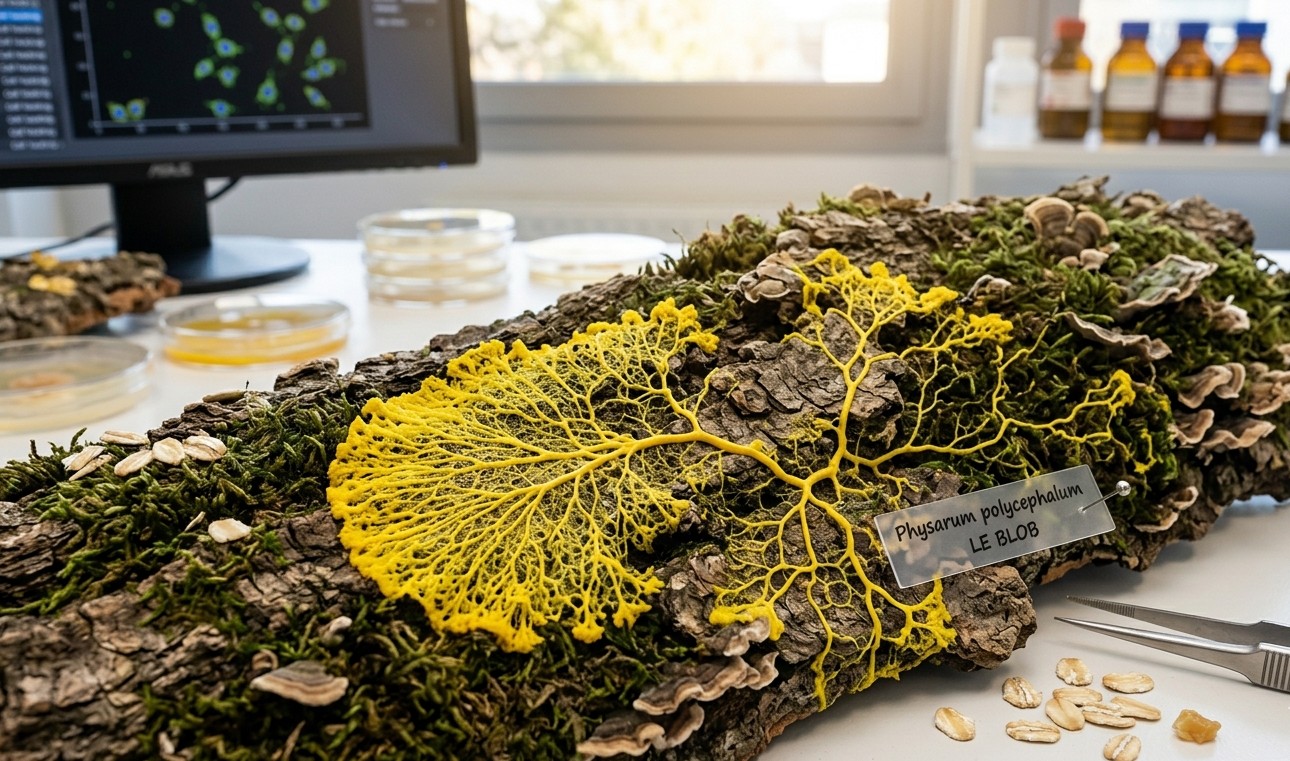
The classification mistake that lasted 200 years
When European naturalists first studied slime molds in the 18th century, the classification seemed obvious. Here were organisms that grew on rotting wood, produced spore-bearing structures, and looked vaguely mushroom-like in their fruiting stage. They were clearly fungi.
This view persisted through the entire 19th century and well into the 20th. Slime molds were studied by mycologists, catalogued in fungal herbaria, and described in mycological journals. It wasn't until molecular biology tools became available in the 1970s and 1980s that the truth became undeniable: slime molds are no more closely related to fungi than they are to humans.
Let that sink in. On the tree of life, the evolutionary distance between a slime mold and a mushroom is roughly the same as the distance between a slime mold and a person.
Where they sit on the tree of life
| Classification level | Slime molds (Myxomycetes) | Fungi |
|---|---|---|
| Domain | Eukaryota | Eukaryota |
| Supergroup | Amoebozoa | Opisthokonta |
| Closest relatives | Amoebas | Animals (yes, really) |
| Class/Phylum | Myxogastria (within Amoebozoa) | Multiple phyla (Ascomycota, Basidiomycota, etc.) |
| Number of known species | ~1,000 | ~150,000 (estimated 2-5 million total) |
The key insight is the "Supergroup" row. Slime molds belong to Amoebozoa, a group of amoeba-like organisms. Fungi belong to Opisthokonta, which also includes all animals. Fungi are more closely related to you than they are to the slime mold on a rotting log. This is not a minor taxonomic detail; it represents over a billion years of independent evolution.
Cell structure: fundamentally different
The most basic biological differences between slime molds and fungi are visible at the cellular level:
| Feature | Slime mold (Physarum) | Fungi |
|---|---|---|
| Cell wall | Absent in the active plasmodium stage (cell membrane only) | Always present; made of chitin |
| Cell organization | Single giant cell (plasmodium) with millions of nuclei sharing one cytoplasm | Filamentous; composed of thread-like hyphae divided into cells by cross-walls (septa) |
| Movement | Actively moves via cytoplasmic streaming and amoeboid locomotion | Grows in one direction by extending hyphal tips; cannot relocate |
| Cytoplasm | Freely flowing; visible shuttle streaming | Compartmentalized within individual hyphal cells |
| Nuclei | Millions of nuclei, all genetically identical, in one shared cell | One or a few nuclei per hyphal cell; some species have genetically different nuclei in the same mycelium (heterokaryosis) |
The absence of a cell wall in the active stage is particularly significant. Fungi always have cell walls, and their walls are made of chitin (the same material found in insect exoskeletons). Slime mold plasmodia have no wall at all. They are essentially a naked mass of flowing cytoplasm enclosed only by a cell membrane. This is why slime molds feel wet and gelatinous while most fungi feel firm or woody.
Feeding: engulfing vs. absorbing
This is perhaps the most fundamental biological difference, and it's the one that tells the deepest evolutionary story.
How fungi eat
Fungi are absorptive heterotrophs. They secrete digestive enzymes outside their bodies, breaking down organic matter externally, and then absorb the dissolved nutrients through their cell walls. A mushroom growing on a dead tree is literally dissolving the wood around it and drinking the result. Fungi never engulf or "swallow" food.
How slime molds eat
Slime molds are phagotrophic. They eat by engulfing food particles whole, in a process called phagocytosis. When Physarum polycephalum encounters a bacterium or yeast cell, it flows around it, encloses it in a membrane-bound pocket (a food vacuole), and digests it internally. This is exactly how an amoeba eats. It is nothing like how a fungus eats.
The feeding test
If you're ever unsure whether something is a slime mold or a fungus, consider what it's growing on. Fungi grow into their food source, sending hyphae deep into wood or soil. Slime molds grow across surfaces, engulfing bacteria and particles as they go. A slime mold on a log is hunting on the surface, not digesting the log itself. For more details, see how slime mold eats.
Reproduction: similar-looking, entirely different
The reproductive structures of slime molds and fungi look superficially similar (both produce spore-bearing structures on stalks), which is the main reason they were historically confused. But the underlying biology is completely different.
| Feature | Slime mold | Fungi |
|---|---|---|
| Spore-bearing structure | Sporangium: entire organism transforms into fruiting structures | Fruiting body (mushroom, bracket, etc.): produced by the mycelium, which continues to live |
| Spore production | Meiosis within sporangia produces haploid spores | Varies: meiosis in basidia (Basidiomycota) or asci (Ascomycota) |
| Spore germination | Produces amoeba-like cell or flagellated cell | Produces a hypha (filament) |
| Sexual system | 720+ mating types (in Physarum) | Typically 2 mating types, sometimes more |
| After sporulation | The plasmodium is consumed; it "dies" to reproduce | The mycelium survives and continues growing |
The fact that both groups produce spore-bearing structures is a case of convergent evolution: two unrelated lineages arriving at similar solutions to the same problem (airborne spore dispersal). The structures look similar because physics and aerodynamics favor certain shapes for launching tiny particles into the air, not because the organisms share a common ancestor that made spores.
For the complete Physarum reproductive cycle, see our article on slime mold reproduction.
Movement: one can, one can't
This is the difference that's most obvious to anyone observing both organisms:
- Slime molds move. The plasmodium of Physarum polycephalum crawls across surfaces at speeds of up to 1-4 cm per hour. It actively explores its environment, moves toward food, retreats from light, and navigates around obstacles. You can watch it move in real-time if you're patient, or in stunning time-lapse videos.
- Fungi do not move. A fungal mycelium grows by extending the tips of its hyphae. Growth is directional, and fungi can "grow toward" food sources by extending hyphae preferentially in certain directions. But a fungus cannot pick up and relocate. Once a hypha is laid down, it stays where it is.
The mechanism behind slime mold movement is cytoplasmic streaming: rhythmic contractions of the tube network push cytoplasm in coordinated waves, generating the force that drives locomotion. Fungi have nothing equivalent.
Ecological roles: overlapping niches, different methods
Despite their biological differences, slime molds and fungi occupy some of the same ecological spaces:
| Ecological function | Slime mold contribution | Fungal contribution |
|---|---|---|
| Decomposition | Minor direct role; feeds on microbes that decompose organic matter | Major role; primary decomposers of wood, leaves, and other plant material |
| Nutrient cycling | Redistributes nutrients by transporting them through its network | Breaks down complex molecules into simpler forms accessible to plants |
| Microbial population control | Significant; consumes large numbers of bacteria and yeast | Some fungi parasitize bacteria, but this is not their primary role |
| Food web | Eaten by beetles, slugs, mites, and nematodes | Eaten by a vast range of animals (humans included) |
| Spore dispersal | Wind, water, invertebrates | Wind, water, animals, active launch mechanisms |
An important distinction: fungi are the primary decomposers in most ecosystems. They produce enzymes that break down cellulose, lignin, and other tough plant materials. Slime molds do not decompose wood or plant matter directly. Instead, they feed on the microorganisms that do the decomposing. Ecologically, slime molds are more like predators that patrol the decomposition zone, while fungi are the demolition crew.
Why the confusion lasted so long
The historical misclassification of slime molds as fungi was not simply a mistake. It was a reasonable conclusion given the available evidence, for several reasons:
- They grow in the same places. Both are found on rotting wood, leaf litter, and damp forest floors.
- They produce similar-looking spore structures. Without molecular tools, the convergent evolution of sporangia was impossible to distinguish from shared ancestry.
- The active stage is rarely observed. Most naturalists encountered slime molds only in their sporulating stage (which looks fungal), not their plasmodial stage (which looks amoeboid). The bright yellow, crawling plasmodium is ephemeral and hidden in dark, moist microhabitats.
- Taxonomy was morphology-based. Before DNA sequencing, organisms were classified by what they looked like. Spore-bearing structures on rotting wood looked like fungi, so they were classified as fungi.
- Institutional inertia. Slime molds were studied by mycology departments, published in mycology journals, and stored in fungal herbaria. Reclassifying them required overcoming decades of organizational habit.
The reclassification came gradually through the 1970s and 1980s as molecular phylogenetics revealed the true evolutionary relationships. By the 1990s, no serious biologist still considered slime molds to be fungi. But the popular confusion persists to this day, partly because many field guides and general-audience texts still discuss them in the context of mycology.
So what is a slime mold?
Slime molds belong to the Amoebozoa, a group defined by their amoeba-like cell movement. Physarum polycephalum is, at its core, a giant amoeba. It engulfs food, flows across surfaces, and has no cell wall. The fact that it produces spore-bearing structures is a remarkable evolutionary innovation, but it doesn't make it a fungus any more than a bat's wings make it a bird. For the full picture, see what is slime mold.
Quick-reference comparison chart
| Feature | Slime mold | Fungus |
|---|---|---|
| Kingdom/Supergroup | Amoebozoa | Fungi (Opisthokonta) |
| Cell wall | None (active stage) | Chitin |
| Feeding | Engulfs food (phagocytosis) | Absorbs dissolved nutrients |
| Movement | Yes, active locomotion | No (only growth) |
| Body form | Single multinucleated cell | Filamentous mycelium |
| Decomposition role | Indirect (eats decomposers) | Direct (breaks down plant material) |
| Mating types | 720+ (Physarum) | Typically 2 |
| Spores | Yes | Yes |
| Closest animal relative? | Amoeba | Animals (including humans) |
The next time someone calls slime mold a fungus, you'll know better. And you'll understand why the distinction matters: these two groups represent completely independent experiments in how to make a living as a decomposer-zone organism on planet Earth.