Why slime mold works in the classroom
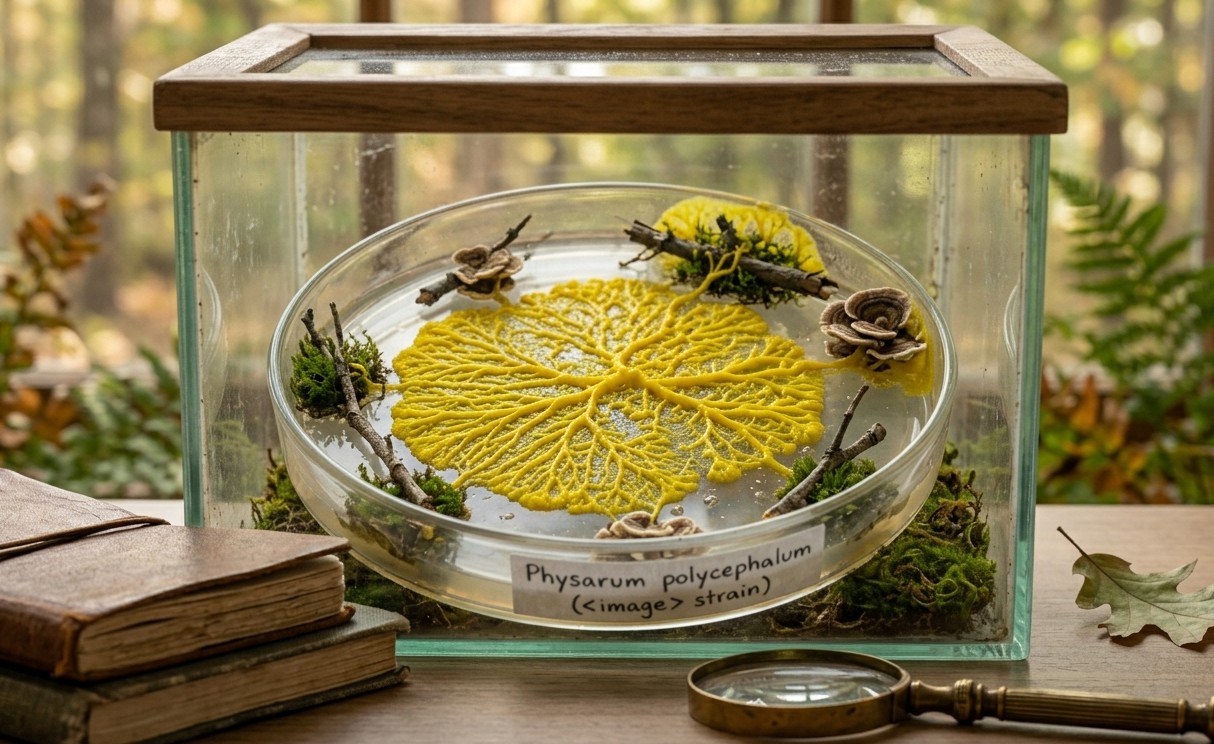
Physarum polycephalum is an ideal teaching organism for several reasons:
- It is safe. Non-toxic, non-parasitic, and not harmful to humans. No special permits or safety equipment needed.
- It is affordable. A single starter culture costs a few euros and can be maintained indefinitely with rolled oats and water.
- It is fast. Visible growth and behavior changes happen within hours, fitting neatly into a class period or a multi-day project.
- It provokes questions. A brainless organism that solves mazes and makes decisions challenges students' assumptions about intelligence, life, and classification.
- It crosses disciplines. Biology, ecology, mathematics, computer science, and even ethics can all be explored through slime mold activities.
Getting started: supplies and preparation
Essential supplies
| Item | Approximate cost | Where to find it |
|---|---|---|
| Physarum polycephalum culture (sclerotium or active) | 5-15 € | Online science suppliers, educational supply companies |
| Petri dishes (9 cm, plastic) | 5-10 € for 20 | Science supply stores, online |
| Agar powder (plain, not nutrient) | 5-8 € | Grocery stores (baking aisle) or online |
| Rolled oats (plain, non-instant) | 1-2 € | Any grocery store |
| Spray bottle | 1-3 € | Dollar store, hardware store |
| Aluminum foil | 1-2 € | Any grocery store |
| Magnifying glasses (optional) | 5-15 € for a set | Educational supply stores |
Preparation timeline
- 1-2 weeks before: Order or obtain a Physarum culture. If ordering a sclerotium, allow time for revival (24-48 hours).
- 3 days before: Revive the sclerotium and begin feeding to establish a healthy, growing culture.
- Day before: Prepare agar plates. Dissolve 2g agar in 100ml water, heat until clear, pour into Petri dishes (thin layer), and let cool and solidify.
- Day of activity: Transfer small pieces of active slime mold to student plates using a clean spatula or tweezers.
Budget-friendly alternatives
No Petri dishes? Use small, clear food containers with lids. No agar? Damp paper towels work as a substrate, though agar gives cleaner results and is easier for observation. One starter culture can be divided to create enough material for an entire class.
Activities by grade level
Elementary school (ages 6-10)
Activity 1: Meet the blob
Duration: 30-45 minutes
Objective: Observe a living organism and describe its characteristics.
Give each group a Petri dish with an active slime mold. Ask students to draw what they see, describe the color, texture, and shape. Is it an animal? A plant? A fungus? Let them share ideas before revealing that it is none of these. Introduce the concept of protists and discuss why this organism does not fit neatly into familiar categories.
Activity 2: What does it eat?
Duration: Setup 20 minutes, observation over 24 hours
Objective: Conduct a simple experiment and record observations.
Have students place different food items (oat, rice grain, small piece of apple, small piece of mushroom) at equal distances from the slime mold. Predict which food it will go to first. Check results the next day. Discuss: was your prediction correct? Why might the slime mold prefer certain foods?
Activity 3: Growth journal
Duration: 5-10 minutes daily over one week
Objective: Practice observation and recording skills.
Each student or group maintains a daily journal, drawing the slime mold and noting changes in size, shape, color, and direction of growth. At the end of the week, compare journals and discuss patterns.
Middle school (ages 11-14)
Activity 4: The maze challenge
Duration: Setup 30-45 minutes, observation over 24 hours
Objective: Understand problem-solving without a brain.
Students build simple mazes from cardboard or plastic strips on agar plates (see maze-building guide). Place slime mold at the entrance and food at the exit. Observe and photograph results. Compare the slime mold's solution to the shortest possible path. Discuss how an organism without a brain or nervous system can solve spatial problems.
Activity 5: Designing a fair experiment
Duration: 45 minutes setup, 24-48 hours observation
Objective: Learn the scientific method through experimental design.
Ask students to design their own experiment testing one variable: Does slime mold prefer light or dark? Warm or cool? Wet or dry? Students must identify their variable, create a hypothesis, design a controlled experiment, collect data, and write a conclusion. This activity teaches experimental design using a genuinely engaging organism.
Activity 6: Classification debate
Duration: 30-40 minutes
Objective: Understand biological classification and its limitations.
Present students with the characteristics of slime mold and ask them to classify it. It eats like an animal. It produces spores like a fungus. It has no brain, no stomach, and no permanent shape. It is a single cell with millions of nuclei. Where does it belong? This activity reveals that classification systems are human constructs, and not every organism fits neatly into a box.
High school (ages 15-18)
Activity 7: Network optimization
Duration: Setup 30 minutes, observation over 48 hours, analysis 1 hour
Objective: Connect biology to mathematics and computer science.
Place oat flakes at positions corresponding to cities on a regional map. Let the slime mold build its network, then compare it to actual highway or rail maps. Discuss Steiner trees, minimum spanning trees, and how biological algorithms compare to computational ones. This connects to graph theory, optimization, and the Tokyo rail experiment.
Activity 8: Habituation experiment
Duration: 15-20 minutes daily over 5-7 days
Objective: Explore learning and memory in organisms without nervous systems.
Recreate the habituation experiment: create a bridge coated with caffeine (from dissolved instant coffee) between the slime mold and its food. Measure crossing time each day. As the slime mold habituates, crossing times decrease. Discuss what "learning" means and whether it requires a brain. Connect to slime mold memory research.
Activity 9: Data collection and statistical analysis
Duration: 1 week setup and observation, 1-2 hours analysis
Objective: Practice data collection, graphing, and statistical analysis.
Run any of the above experiments with multiple replicates (at least 3-5 per condition). Students collect quantitative data (growth rates, crossing times, distances), create graphs, calculate means and standard deviations, and determine whether differences between conditions are statistically significant. This is real science with real data.
Curriculum connections
| Subject | Topics covered | Relevant activities |
|---|---|---|
| Biology | Cell biology, classification, protists, behavior, ecology | All activities |
| Mathematics | Measurement, graphing, statistics, graph theory, optimization | Speed measurement, network building, data analysis |
| Computer science | Algorithms, optimization, biological computing | Maze solving, network building |
| Philosophy / Ethics | What is intelligence? What is learning? Animal classification | Memory test, classification debate |
| Art | Scientific illustration, time-lapse photography | Growth journal, photography project |
| English / Writing | Lab reports, persuasive writing, science communication | Any experiment with written analysis |
Safety guidelines
Physarum polycephalum is one of the safest organisms for classroom use, but follow these guidelines:
- Hand washing: Students should wash hands before and after handling cultures. Not because the slime mold is dangerous, but to practice good lab hygiene and to protect the culture from contamination.
- No eating: Do not eat the slime mold or any food used in experiments. Although Physarum is not toxic, the agar and oats may develop bacterial contamination.
- Allergy awareness: In rare cases, students with strong mold allergies may react to slime mold cultures. Ask about allergies before starting. Affected students can participate in data analysis and discussion without handling the cultures directly.
- Contamination management: If bacterial or fungal contamination appears (fuzzy growth, unpleasant smell), seal the dish and dispose of it in regular waste. Do not open contaminated dishes near other cultures.
- Disposal: Used cultures can go in regular household waste. Seal the Petri dish, place in a bag, and discard. There is no need for special biohazard disposal.
Supervised activities only
While slime mold itself is safe, the agar preparation involves boiling water and hot liquids. Always prepare agar plates yourself before class, or supervise closely if students are involved in preparation.
Frequently asked questions from teachers
Can I keep the culture over school holidays?
Yes. Create a sclerotium before a long break and revive it when you return. For short breaks (up to 2 weeks), refrigerator storage works well.
How many students can one culture supply?
A healthy, well-established culture can be divided into 15-20 pieces for individual or small-group work. Start culturing 1-2 weeks before your planned lesson to build up enough material.
What if it escapes the Petri dish?
It happens, and it is not a problem. Slime mold cannot survive long on dry surfaces. Simply place the escaped portion back on damp agar. To prevent escapes, ensure the lid fits snugly and keep the environment inside the dish humid enough that the slime mold does not need to go looking for moisture elsewhere.
Can students take cultures home?
Absolutely. Send them home with a small piece on a damp paper towel in a sealed container, along with a few oat flakes and basic care instructions. Many students become genuinely fascinated and continue observing at home.
For more experiment ideas, see our 10 slime mold experiments guide. To understand more about the organism itself, explore What is slime mold? and Slime mold intelligence.