
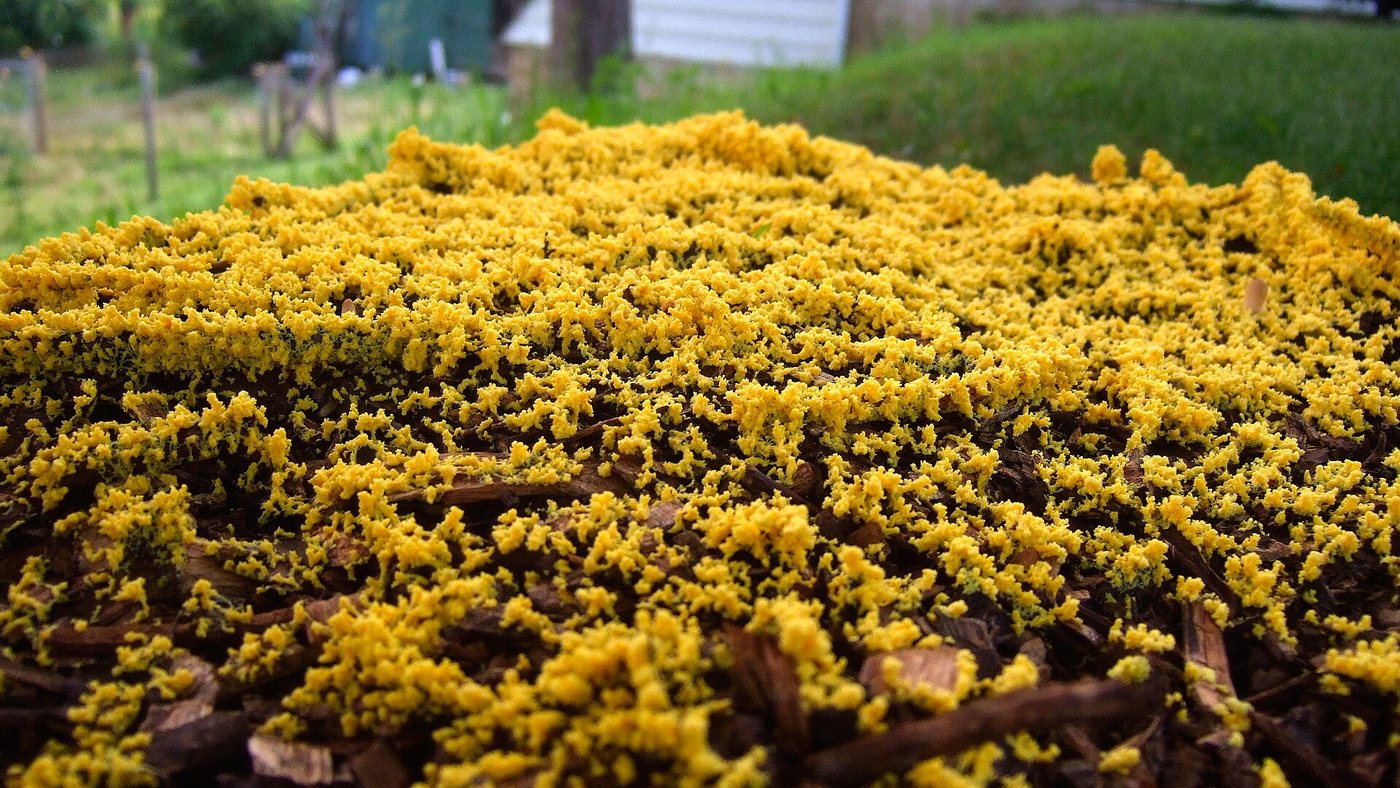
A bright yellow, spongy blob that showed up overnight on your mulch is almost certainly dog vomit slime mold, Fuligo septica. Despite the name, it is not a fungus and not a plant. It is a slime mold, a close relative of Physarum polycephalum, the slime mold scientists study in the lab. It will not hurt your plants, it is not toxic to dogs or cats, and it goes away on its own within days.
The one thing to watch is the dust it releases at the end of its life, which can bother people with asthma or mold allergies. Before going any further, make sure that is really what you have, using the two questions below.
Identify it in two questions
Answer both questions to see the result.
Dog vomit slime mold, by far the most common culprit
It also goes by "scrambled egg slime," and both nicknames are a fair description. It turns up from spring to fall, after a stretch of warm, rainy weather, on bark and wood-chip mulch, woodpiles, stumps and sometimes lawns. What it feeds on is the bacteria and debris breaking the mulch down, not your plants.
For a day or two it stays soft and bright yellow, and it can even creep a few centimeters. Then it sets into a tan to brown crust. Inside, that crust fills with a dark powder, which is its spores. The wind carries them off, and soon all that is left is a dry, sometimes whitish patch that crumbles away.
It is harmless to your garden and your pets
This is not a plant disease. It can grow over a stem or a seedling without damaging it, because it treats the plant like any other surface to sit on. University extension services in the United States and Canada, which get worried calls about it every summer, describe it as harmless to plants, people and pets.
A dog that eats a piece might get a mild upset stomach at worst, and sniffing the dry crust can make it sneeze. For people, the real precaution is the spore dust, which can irritate the airways of anyone with asthma or a mold allergy. If that applies to you, avoid stirring up the dry crust and do not lean over it for long.
What to do when it shows up
The easiest option is to leave it alone. It finishes its cycle and disappears in one to two weeks. If you would rather get rid of it, scoop it up with a shovel while it is still soft, put it in a sealed bag and throw it out with the household trash. Skip the pressure washer, which spreads the spores around instead of removing them.
Fungicides do nothing, because it is not a fungus. To see less of it, turn the mulch over now and then to let air in, water only as much as you need to, and let the surface dry out between waterings. A mineral mulch such as gravel or slate gives it nothing to eat.
Look-alikes to rule out first
| What you see | Where | What it is | What to do |
|---|---|---|---|
| Thick bright yellow foam that dries into a brown crust | Mulch, stumps, lawn | Dog vomit slime mold (Fuligo septica), a slime mold | Nothing, or scoop it up while soft |
| Flat network of yellow veins | Dead wood, leaves, shade | A network-forming slime mold such as Physarum polycephalum | Nothing, it moves on |
| Chalky white crust coating the grass | Lawn, stems | Mucilago crustacea, another slime mold | Nothing, mowing removes it |
| Small pink balls that turn gray | Dead wood | Wolf's milk (Lycogala epidendrum), a slime mold | Nothing |
| Folded golden yellow jelly | Dead branches, mostly in winter | Yellow brain fungus (Tremella mesenterica) | Nothing |
| Soft green to brown jelly after rain | Gravel, paths, short lawn | Star jelly (Nostoc), a cyanobacteria colony | Nothing, or improve drainage |
| Large stacked orange-yellow shelves | Trunk of a living tree | Chicken of the woods (Laetiporus sulphureus), a wood-rotting fungus | Have the tree checked |
| Small lemon-yellow mushrooms | Houseplant pot | Yellow houseplant mushroom (Leucocoprinus birnbaumii) | Pull them out, keep kids and pets away |
Only two of these call for action. Chicken of the woods means the wood is rotting from the inside, and an affected tree near a house or a path deserves a look from an arborist. The yellow houseplant mushroom is considered poisonous if eaten, so it is best removed when children or pets are around.
How it relates to the famous slime mold
The slime mold used in labs and classrooms, Physarum polycephalum, belongs to the same broad group as dog vomit slime mold. It also lives outdoors, mostly in woodland, on damp dead wood and under leaves. You can tell it apart by its well-defined network of veins, where dog vomit slime mold forms a compact mass. To go looking for one, our guide to finding slime mold in the wild covers the right places and the right season, and the page on slime mold species introduces its many relatives.
Frequently asked questions
Is the yellow stuff on my mulch dangerous?
Not if it is dog vomit slime mold. It does not attack plants and is not toxic to pets. Only the spore dust at the end of its cycle can bother people with asthma or allergies.
Should I spray the mulch with fungicide?
No. Dog vomit slime mold is not a fungus, so fungicide has no effect on it. Airing the mulch and watering less make it come back less often.
My dog ate some. What should I do?
It is not considered toxic. A large amount might cause a mild upset stomach at worst. If symptoms last, call your vet.
Why does it come back every summer?
Its spores stay in the mulch and in the air. As soon as warm, humid weather returns to an organic mulch full of bacteria, it has food again and reappears.
Is it the same slime mold scientists study?
Not quite, it is a related species. The lab slime mold, Physarum polycephalum, forms a network of yellow veins and lives mostly in woodland on dead wood.
Sources
- University of Saskatchewan, Dog vomit slime mold, Gardening at USask.
- University of California Agriculture and Natural Resources, Slime mold (dog vomit slime mold), Fuligo septica.
- University of Missouri Extension, Warm, wet weather helps dog vomit slime mold thrive.
- Fuligo septica, Wikipedia.