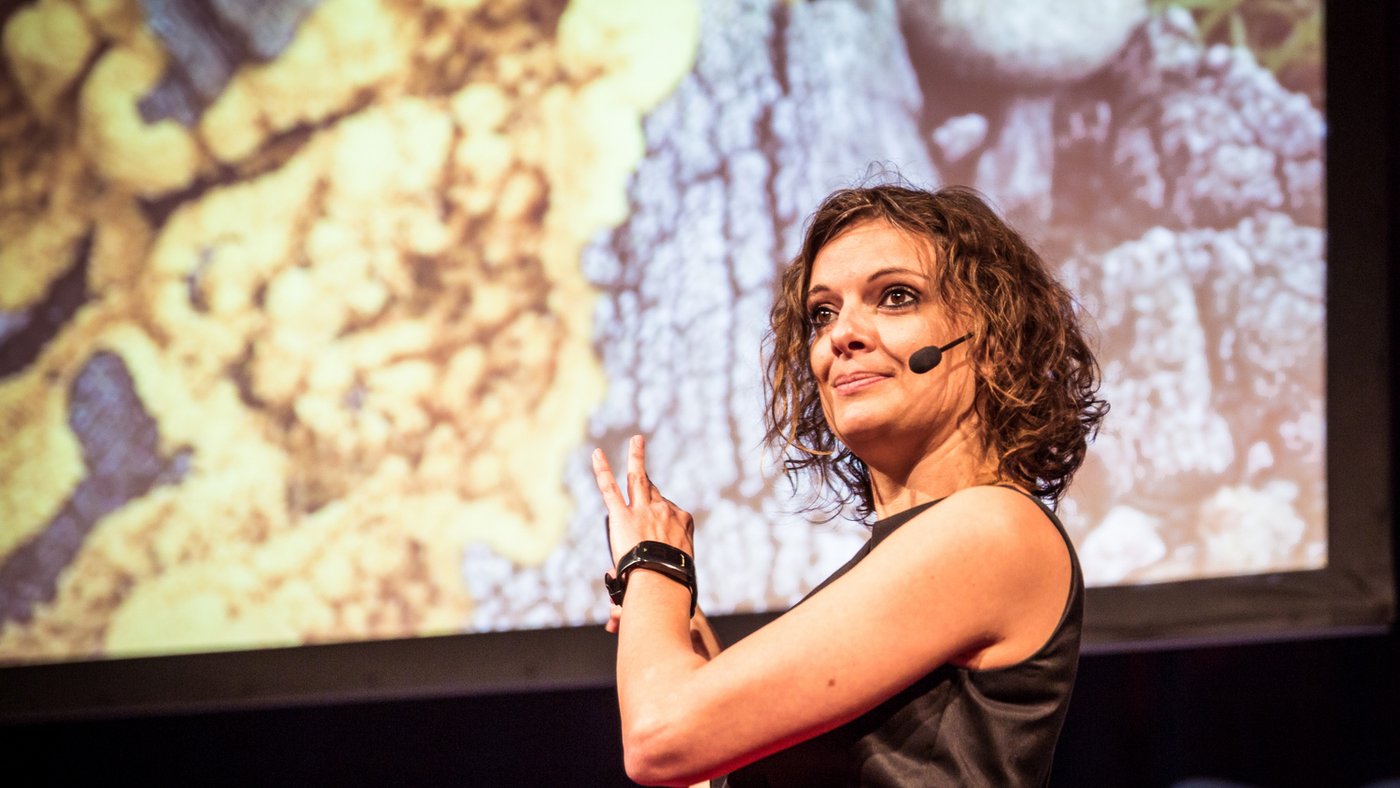
Audrey Dussutour is a research director at CNRS, France's national research agency, based at the Research Center on Animal Cognition in Toulouse. Trained as an ant specialist, she took up slime mold in 2008 and went on to show that a single cell with no brain can balance its diet, learn, and pass what it has learned to another slime mold. In France she is also the person who made slime mold famous, under its French nickname le blob, through her books, her talks and two experiments run with thousands of schoolchildren and volunteers.
From ants to slime mold
Born in Rodez, in southern France, in 1977, she earned her PhD on ants from the University of Toulouse III in 2004, supervised by Vincent Fourcassié and Jean-Louis Deneubourg. Her thesis looked at how ant colonies keep traffic flowing on their trails with no jams and nobody directing it, and part of that work was published in Nature the same year.
Postdoctoral posts followed at Concordia University in Montreal, then at the University of Sydney in Stephen Simpson's group, which studies nutrition in insects. It was in Sydney, in 2008, that she first worked with Physarum polycephalum. She saw in it the perfect model for a question her ants had already raised: how does a system with no control center make decisions? She joined CNRS in 2009 and brought her slime molds back to Toulouse.
Her main discoveries
A balanced diet without a brain (2010)
Working with Tanya Latty, Madeleine Beekman and Stephen Simpson, she showed that slime mold grows best on food with roughly twice as much protein as carbohydrate. Given a choice of unbalanced foods, it spreads its network across them in proportions that recreate that ideal mix. The experiment is described in detail on our page about how slime mold eats.
Slime mold can learn (2016)
With Romain Boisseau and David Vogel, she set slime molds in front of a bridge they had to cross to reach food, coated with quinine or caffeine, two substances they normally avoid. Day after day the slime molds hesitated less, until they crossed as if the bridge were plain. The team checked that this change met the criteria used to define habituation in animals. It was the first demonstration of this kind of learning in an organism without neurons.
Slime mold can pass on what it learned (2016)
The same year, she and David Vogel fused a slime mold that had grown used to salt with one that had never met it. The merged slime mold crossed salt without hesitating, just as the "trained" one would have. The transfer worked even when trained slime molds were a minority in the fusion, provided it lasted long enough for their contents to mix. The full story is on our page about memory without a brain.
Making slime mold a household name in France
In 2017 she published a book for the general public whose title translates as Everything You Always Wanted to Know About Slime Mold but Were Afraid to Ask (Éditions des Équateurs). It won France's Sciences pour tous book prize and turned "blob," a nickname borrowed from the 1958 science fiction film, into the everyday French name for the species. In 2019 the Paris Zoological Park put a slime mold on public display, and the documentary Le Blob, un génie sans cerveau ("The Blob, a Genius Without a Brain") by Jacques Mitsch drew heavily on her work.
She then designed, with the French space agency CNES, the operation known in France as Élève ton blob. In 2021 four slime molds flew to the International Space Station with astronaut Thomas Pesquet, while thousands of French classes ran the same experiment on the ground. In spring 2022 a citizen science project, Derrière le blob, la recherche ("Behind the blob, the research"), brought in around 15,000 volunteers who raised slime molds at home to record how they reacted to different conditions, including temperature. Much of slime mold's place in popular culture in France comes from these two operations.
| Year | Book (in French) | Publisher |
|---|---|---|
| 2017 | Tout ce que vous avez toujours voulu savoir sur le blob sans jamais oser le demander | Équateurs |
| 2022 | L'odyssée des fourmis ("The Ant Odyssey"), with Antoine Wystrach | Grasset |
| 2022 | Moi, le blob ("Me, the Blob"), for children | HumenSciences |
| 2025 | Les champignons de l'apocalypse ("The Mushrooms of the Apocalypse") | Grasset |
Awards and honors
Her PhD on ants earned her the Le Monde university research prize in 2007, followed by the Adolphe Wetrems prize from the Royal Academy of Belgium in 2011. In 2021, the year slime mold went to space, she received the CNRS medal for science outreach and was appointed to France's National Order of Merit. In 2023 the Royal Academy of Belgium elected her an associate member.
Where to go next
If you read French, her 2017 book is still the best introduction to slime mold. To watch one at home, our guide to growing slime mold explains how to get one and keep it healthy, and our experiments at home borrow several of her protocols.
Frequently asked questions
Did Audrey Dussutour discover slime mold?
No. Physarum polycephalum was described in the 19th century and has been studied in labs for decades. What she did was show that it can learn, and make it famous in France.
Why do the French call slime mold "le blob"?
The nickname comes from the science fiction film The Blob (1958), in which a gelatinous mass swallows everything in its path. It caught on in France with her 2017 book and the Paris Zoo exhibit in 2019.
Where does she work?
At the Research Center on Animal Cognition (CRCA) in Toulouse, a lab run by CNRS and the University of Toulouse III, where she is a research director.
Was sending slime mold to space her idea?
CNES designed the operation together with her. She supplied the slime molds, of strain LU352, and wrote the protocol followed by the crew and by the classes.
Sources
- Audrey Dussutour, French Wikipedia.
- Dussutour A., Latty T., Beekman M., Simpson S. J., Amoeboid organism solves complex nutritional challenges, PNAS 107 (2010).
- Boisseau R. P., Vogel D., Dussutour A., Habituation in non-neural organisms: evidence from slime moulds, Proceedings of the Royal Society B 283 (2016).
- Vogel D., Dussutour A., Direct transfer of learned behaviour via cell fusion in non-neural organisms, Proceedings of the Royal Society B 283 (2016).