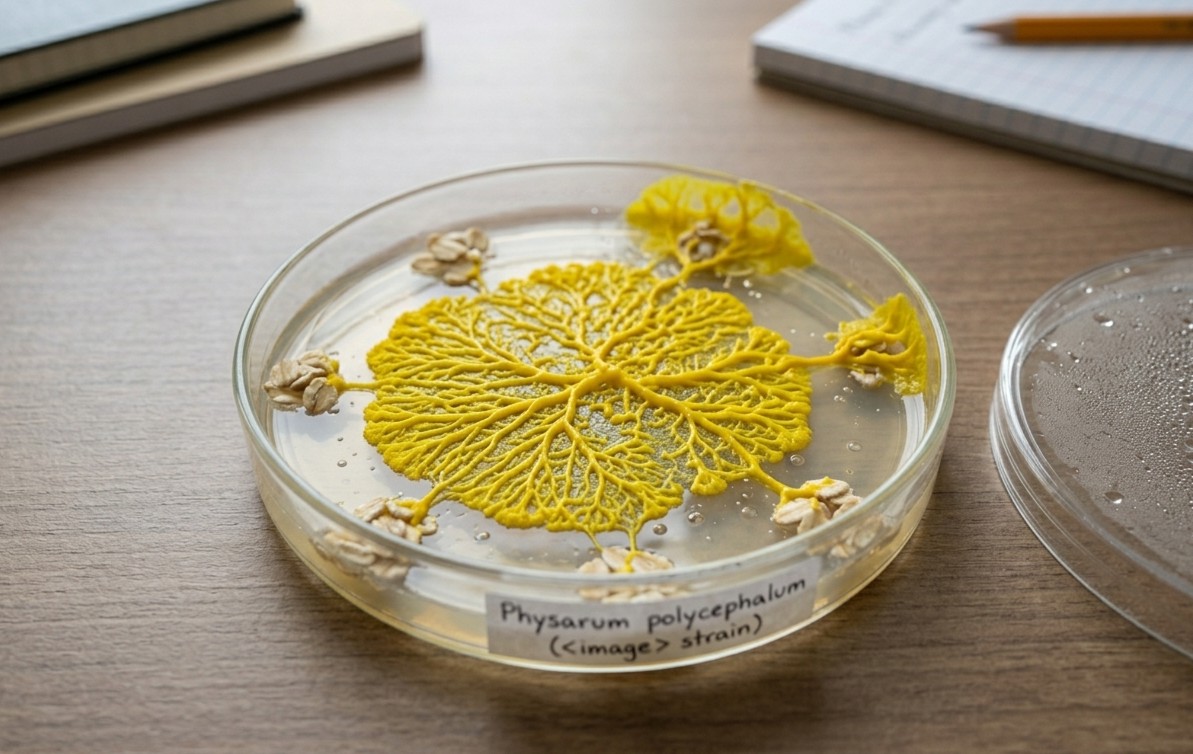
Sensation without senses
When a human touches a hot stove, a chain of events unfolds: nerve endings in the skin detect the heat, electrical signals race through neurons to the spinal cord, a reflex arc triggers muscle contraction, and the hand pulls away. Somewhere in this process, the person also experiences pain.
Physarum polycephalum has none of this hardware. No neurons, no nerve endings, no spinal cord, no brain. And yet, if you place a hot object near the organism, it moves away. If you shine a light on it, it retreats. If you put salt in its path, it reroutes.
The organism clearly responds to stimuli. The question is whether "response" is the same thing as "feeling."
What slime mold can detect: a complete inventory
Decades of laboratory research have mapped out the sensory world of Physarum in considerable detail. Here is what the organism can and cannot detect:
| Stimulus | Response | Sensitivity | Mechanism (known or hypothesized) |
|---|---|---|---|
| Light (blue/UV) | Strong avoidance (negative phototaxis) | Very high; responds to dim light | Photoreceptor proteins in the cell membrane (likely phytochromes) |
| Light (red/far-red) | Mild attraction in some conditions | Moderate | Separate photoreceptor system, possibly used for orientation |
| Food chemicals | Movement toward source (positive chemotaxis) | Can detect glucose at concentrations below 0.1 mM | Membrane-bound chemoreceptors |
| Repellent chemicals | Avoidance (negative chemotaxis) | Strong response to salt, quinine, heavy metals | Same or similar receptor systems, triggering opposite response |
| Temperature | Prefers 22-25 C; avoids extremes | Can detect gradients of 1-2 C across its body | Temperature-sensitive enzymes and membrane fluidity changes |
| Humidity | Moves toward moisture | High; desiccation triggers dormancy | Osmotic pressure sensing across the membrane |
| Gravity | Weak but measurable gravitaxis | Low; only observable in controlled experiments | Likely related to cytoplasmic density differences |
| Vibration | Altered contraction patterns | Moderate; responds to low-frequency mechanical stimulation | Mechanosensitive ion channels |
| Sound | No confirmed response | None detected in controlled experiments | N/A |
| Magnetic fields | No confirmed response | None detected | N/A |
How light detection works in detail
Light avoidance is the most dramatic and best-studied sensory response in Physarum. It's also the most useful to researchers, who exploit it to create "walls" and barriers in experiments like the Tokyo rail network study.
The mechanism works as follows:
- Photoreceptor activation: Proteins embedded in the cell membrane absorb blue and ultraviolet light. These are similar in structure to photoreceptors found in bacteria and plants, suggesting deep evolutionary origins.
- Signal transduction: The activated photoreceptors trigger a cascade of internal chemical signals, primarily involving calcium ions and cyclic AMP.
- Contraction change: In the illuminated region, the rhythmic contractions of the tube walls slow down. Flow decreases in that area.
- Flow redistribution: Cytoplasm is pushed away from the illuminated zone toward darker regions, where contractions remain normal or increase.
- Movement: The net effect is that the organism physically moves away from the light source.
The entire process takes only minutes. Under intense light, Physarum can retreat at speeds of up to 1-2 cm per hour, which is quite fast for an organism that normally moves at about 1 cm per hour.
Red light exception
Physarum is relatively insensitive to red light. This is why researchers working with the organism in the lab use red illumination for observation, similar to how photographers used red darkroom lights. Under pure red light, the organism behaves as if it were in complete darkness.
Chemical sensing: the slime mold's primary "sense"
If you had to choose one sense as the most important for Physarum, it would be chemoreception. The organism lives and dies by its ability to detect food (primarily bacteria and yeast in the wild, oat flakes in the lab) and avoid toxic substances.
Chemical detection happens across the entire surface of the organism. Every part of the cell membrane is studded with receptor proteins that bind to specific molecules. When food molecules are present, receptors trigger local increases in contraction frequency, pulling the organism toward the source. When toxins are detected, the opposite occurs.
This distributed sensing system means that Physarum doesn't "smell" food the way an animal does (from a distance, through a specialized organ). Instead, it essentially tastes its entire environment simultaneously, through direct molecular contact at thousands of points across its surface.
The gradient problem
One of the most impressive aspects of Physarum's chemical sensing is its ability to detect gradients. If food is placed to the organism's left, the left side of its body detects a higher concentration of food molecules than the right side. This difference, which may be only a few molecules per square micrometer, is enough to bias the organism's movement to the left.
How does a single cell compare concentrations across different parts of its body? The answer lies in the tube network. Local chemical signals modulate local contraction rates. The left side contracts more forcefully (because it detects more food), which pulls cytoplasm from right to left, which causes the whole organism to shift leftward. No comparison, no calculation, no decision in the cognitive sense. Just physics.
Temperature perception
Physarum polycephalum grows optimally between 22 and 25 degrees Celsius. Below 10 C, it enters dormancy. Above 35 C, it begins to die. But the organism doesn't just survive or die at these extremes. It actively responds to temperature gradients.
In laboratory experiments, when one side of the agar plate is warmed and the other cooled, Physarum will migrate toward its preferred temperature zone. It can detect a temperature difference of just 1-2 degrees Celsius across its body length, and it will adjust its movement accordingly.
The mechanism is thought to involve temperature-sensitive enzymes that control contraction rates. At the organism's preferred temperature, these enzymes work optimally, producing strong, regular contractions. At temperatures that are too high or too low, enzyme activity drops, contractions weaken, and flow shifts away from those regions.
The "feeling" question: three levels of analysis
When people ask "Does slime mold feel?" they usually mean one of three things:
Level 1: Does it detect stimuli?
Yes, unambiguously. Physarum detects light, chemicals, temperature, humidity, and mechanical disturbance. This is not debated. The organism has receptor systems that respond to specific physical and chemical inputs.
Level 2: Does it have preferences?
Yes, in a functional sense. Physarum "prefers" darkness over light, moisture over dryness, oats over cellulose, moderate temperatures over extremes. These preferences are consistent, repeatable, and measurable. But whether they are experienced as preferences or simply enacted as mechanical responses is unknown.
Level 3: Does it have subjective experience?
This is where science reaches its current limits. Subjective experience, what philosophers call qualia, refers to the felt quality of sensation. When you see red, there is "something it is like" to see red. Does a slime mold have any analogous inner experience when it detects light?
We have no way to test this. The organism has no brain to scan, no behavior unambiguously linked to consciousness, and no way to communicate its inner states (if it has any). Most biologists would say the answer is almost certainly no, but intellectual honesty demands admitting that we cannot rule it out entirely.
The philosophical angle
Some philosophers, particularly those in the panpsychist tradition, argue that all physical systems have some minimal form of experience. Under this view, even a thermostat "feels" temperature in some rudimentary sense. If panpsychism is correct, then yes, slime mold feels. But panpsychism is a minority position in philosophy of mind, and it is not a scientific claim that can be tested.
Comparing slime mold sensing to animal senses
| Feature | Slime mold | Simple animal (e.g., C. elegans worm) | Complex animal (e.g., human) |
|---|---|---|---|
| Sensory organs | None | Simple (302 neurons total) | Complex (eyes, ears, nose, etc.) |
| Detection mechanism | Membrane receptors across entire body | Specialized sensory neurons | Specialized organs + neural processing |
| Response speed | Minutes to hours | Milliseconds to seconds | Milliseconds |
| Spatial resolution | Low (whole-body gradient detection) | Moderate | Very high (millions of receptors) |
| Signal integration | Physical flow dynamics | Neural circuits | Complex brain processing |
| Learning from stimuli | Yes (habituation) | Yes | Yes |
| Subjective experience | Unknown, probably not | Debated | Yes |
Practical implications: what this means for slime mold keepers
If you grow slime mold at home, understanding its sensory world helps you provide better care:
- Keep it dark: Store your culture in a dark container or cover it with aluminum foil. Light stresses the organism and can trigger premature sporulation.
- Maintain consistent temperature: Room temperature (20-25 C) is ideal. Avoid placing the container near windows, heaters, or air conditioning vents.
- No strong chemicals nearby: Cleaning products, perfumes, and even scented candles can release volatile compounds that repel or harm the organism.
- Keep humidity high: Mist the inside of the container or keep the agar moist. If the organism detects drying conditions, it will enter dormancy.
- Minimize vibration: Don't place the container on a washing machine or next to speakers. Vibration can disrupt the organism's delicate contraction patterns.
None of this means the organism is "suffering" when conditions are wrong. But it does mean that environmental quality directly affects its health, growth, and behavior. Understanding its sensory capabilities is the first step toward keeping it alive and active.
Related reading
For more on the broader intelligence debate, see slime mold intelligence. To understand how these sensory abilities support the organism's feeding behavior, see how slime mold eats.